JAMAL: A Multidimensional Benchmark for Arabic Commonsense Reasoning Across Life-Domains and Cognitive Axes
DOI:
https://doi.org/10.66834/byjwsd23Keywords:
Commonsense Reasoning, Arabic NLP, Language Model Evaluation, Psycholinguistically Grounded Benchmarking, WHO-ICF FrameworkAbstract
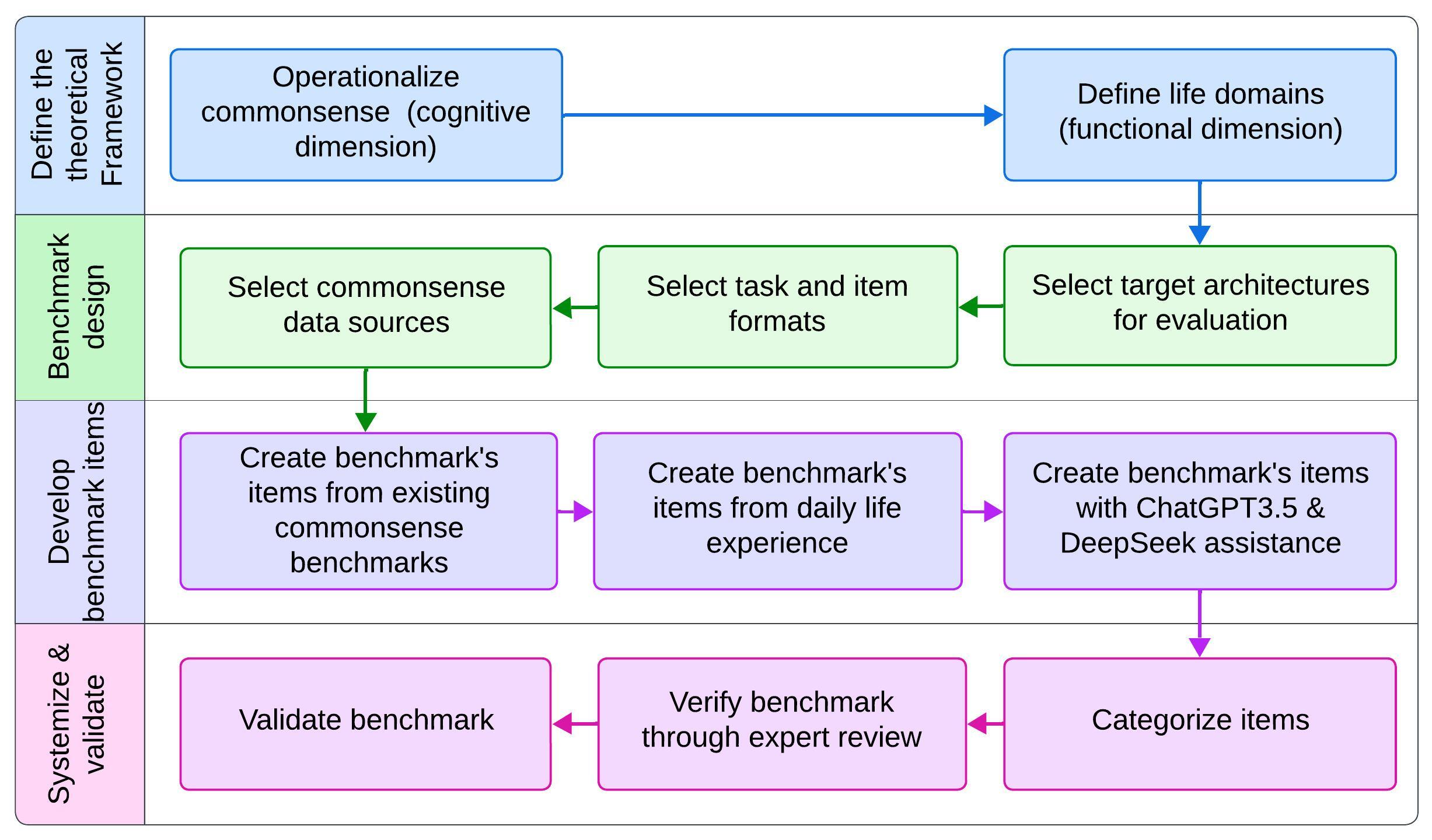
Commonsense is a broad and multifaceted concept, making its evaluation a persistent challenge in natural language processing (NLP). This paper introduces JAMAL (Arabic for “Camel”), a multidimensional framework and benchmark for Arabic commonsense reasoning. JAMAL is structured along three complementary axes: (i) a life-domain axis comprising a taxonomy of 56 functional categories informed by the World Health Organization’s International Classification of Functioning, Disability, and Health (ICF), capturing diverse aspects of daily human experience; (ii) a cognitive axis organizing commonsense into three reasoning types: everyday situations, general knowledge, and problem-solving; and (iii) a cultural grounding axis distinguishing between universal, western/global, and Arabic-specific knowledge. To operationalize this framework, benchmark items are constructed using psycholinguistically inspired principles of constrained contextual prediction. We evaluate five Arabic language models using JAMAL and observe consistent differences in their performance across all axes. Notably, FANAR-27B achieves the strongest overall results among all evaluated models, outperforming FANAR-9B and smaller baselines. Overall, JAMAL provides a structured and interpretable benchmark for evaluating commonsense reasoning in Arabic, supporting the development of more robust language models through systematic analysis of their behavioral limitations.
References
1. T. B. Brown et al., “Language models are few-shot learners,” 2020, doi:https://doi.org/10.48550/arXiv.2005.14165.
2. OpenAI, J. Achiam, S. Adler, S. Agarwal, L. Ahmad et al., “Gpt-4 technical report,” arXiv preprint arXiv:2303.08774, 2023, doi:https://doi.org/10.48550/arXiv.2303.08774. [Online]. Available: https://arxiv.org/abs/2303.08774
3. H. Touvron et al., “Llama 2: Open foundation and finetuned chat models,” arXiv preprint arXiv:2307.09288, 2023. [Online]. Available: https://arxiv.org/abs/2307.09288
4. J. Bai et al., “Qwen technical report,” arXiv preprint arXiv:2309.16609, 2023, doi:https://doi.org/10.48550/arXiv.2309.16609.
5. G. Team et al., “Gemini: A family of highly capable multimodal models,” 2025. [Online]. Available: https://arxiv.org/abs/2312.11805
6. R. Zellers, A. Holtzman, Y. Bisk, A. Farhadi, and Y. Choi, “HellaSwag: Can a machine really finish your sentence?” in Proceedings of the 57th Annual Meeting of the Association for Computational Linguistics, A. Korhonen, D. Traum, and L. Màrquez, Eds. Florence, Italy: Association for Computational Linguistics, Jul. 2019, pp. 4791–4800, doi:https://doi.org/10.18653/v1/P19-1472. [Online]. Available: https://aclanthology.org/P19-1472/ DOI: https://doi.org/10.18653/v1/P19-1472
7. D. Hendrycks et al., “Measuring massive multitask language understanding,” 2021. [Online]. Available: https://arxiv.org/abs/2009.03300
8. G. Lai, Q. Xie, H. Liu, Y. Yang, and E. Hovy, “RACE: Large-scale ReAding comprehension dataset from examinations,” in Proceedings of the 2017 Conference on Empirical Methods in Natural Language Processing, M. Palmer, R. Hwa, and S. Riedel, Eds. Copenhagen, Denmark: Association for Computational Linguistics, Sep. 2017, pp. 785–794, doi:https://doi.org/10.18653/v1/D1 7-1082. [Online]. Available: https://aclanthology.org/D17-1082/ DOI: https://doi.org/10.18653/v1/D17-1082
9. A. Abdelali et al., “LAraBench: Benchmarking Arabic AI with large language models,” in Proceedings of the 18th Conference of the European Chapter of the Association for Computational Linguistics (Volume 1: Long Papers), Y. Graham and M. Purver, Eds. St. Julian’s, Malta: Association for Computational Linguistics, Mar. 2024, pp. 487–520, doi:https://do i.org/10.18653/v1/2024.eacl-long.30. [Online]. Available: https://aclanthology.org/2024.eacl-long.30/ DOI: https://doi.org/10.18653/v1/2024.eacl-long.30
10. M. T. I. Khondaker, A. Waheed, E. M. B. Nagoudi, and M. Abdul-Mageed, “GPTAraEval: A comprehensive evaluation of ChatGPT on Arabic NLP,” in Proceedings of the Conference on Empirical Methods in Natural Language Processing, H. Bouamor, J. Pino, and K. Bali, Eds. Singapore: Association for Computational Linguistics, Dec. 2023, pp. 220–247, doi:https://doi.org/10.18653/v1/2023.emnlp-main.16. [Online]. Available: https://aclanthology.org/2023.emnlp-main.16/ DOI: https://doi.org/10.18653/v1/2023.emnlp-main.16
11. F. Koto et al., “ArabicMMLU: Assessing massive multitask language understanding in Arabic,” in Findings of the Association for Computational Linguistics: ACL 2024, L.-W. Ku, A. Martins, and V. Srikumar, Eds. Bangkok, Thailand: Association for Computational Linguistics, Aug. 2024, pp. 5622–5640, doi:https://doi.org/10.18653/v1/2024.findings-acl.334. [Online]. Available: https://aclanthology.org/2024.findings-acl.334/ DOI: https://doi.org/10.18653/v1/2024.findings-acl.334
12. B. Mousi et al., “AraDiCE: Benchmarks for dialectal and cultural capabilities in LLMs,” in Proceedings of the 31st International Conference on Computational Linguistics, O. Rambow, L. Wanner, M. Apidianaki, H. Al-Khalifa, B. D. Eugenio, and S. Schockaert, Eds. Abu Dhabi, UAE: Association for Computational Linguistics, Jan. 2025, pp. 4186–4218. [Online]. Available: https://aclanthology.org/2025.coling-main.283/
13. R. N. Almatham et al., “BALSAM: A platform for benchmarking Arabic large language models,” in Proceedings of The Third Arabic Natural Language Processing Conference, K. Darwish et al., Eds. Suzhou, China: Association for Computational Linguistics, Nov. 2025, pp. 258–277, doi:https://doi.org/10.18653/v1/2025.arabicnlp-main.21. [Online]. Available: https://aclanthology.org/2025.arabicnlp-main.21/ DOI: https://doi.org/10.18653/v1/2025.arabicnlp-main.21
14. S. Al-Khalifa, N. Durrani, H. Al-Khalifa, and F. Alam, “The landscape of arabic large language models,” Communications of the ACM, vol. 68, no. 10, pp. 54–61, 2025, doi:https://doi.org/10.1145/3737453. DOI: https://doi.org/10.1145/3737453
15. K. Smith et al., “The origins of common sense in humans and machines,” in Proceedings of the Annual Meeting of the Cognitive Science Society, vol. 42, 2020, pp. 3–4. [Online]. Available: https://escholarship.org/uc/item/2367w9c4
16. S. K. Tawalbeh and M. Al-Smadi, “Is this sentence valid? an arabic dataset for commonsense validation,” CoRR, vol. abs/2008.10873, 2020. [Online]. Available: https://arxiv.org/abs/2008.10873
17. N. Sengupta et al., “Jais and jais-chat: Arabic-centric foundation and instruction-tuned open generative large language models,” 2023. [Online]. Available: https://arxiv.org/abs/2308.16149
18. M. S. Bari et al., “ALLam: Large language models for arabic and english,” in The Thirteenth International Conference on Learning Representations, 2025. [Online]. Available: https://openreview.net/forum?id=MscdsFVZrN
19. F. Team et al., “Fanar: An arabic-centric multimodal generative ai platform,” 2025. [Online]. Available: https://arxiv.org/abs/2501.13944
20. World Health Organization, International Classification of Functioning, Disability and Health (ICF). Geneva: World Health Organization, 2001. [Online]. Available: https://www.who.int/classifications/icf/en/
21. R. Zellers, Y. Bisk, R. Schwartz, and Y. Choi, “SWAG: A large-scale adversarial dataset for grounded commonsense inference,” in Proceedings of the Conference on Empirical Methods in Natural Language Processing, E. Riloff, D. Chiang, J. Hockenmaier, and J. Tsujii, Eds. Brussels, Belgium: Association for Computational Linguistics, Oct.-Nov. 2018, pp. 93–104, doi:https://doi.org/10.18653/v1/D18-1009. [Online]. Available: https://aclanthology.org/D18-1009/ DOI: https://doi.org/10.18653/v1/D18-1009
22. A. Talmor, J. Herzig, N. Lourie, and J. Berant, “CommonsenseQA: A question answering challenge targeting commonsense knowledge,” in Proceedings of the 2019 Conference of the North American Chapter of the Association for Computational Linguistics: Human Language Technologies, Volume 1 (Long and Short Papers), J. Burstein, Basma Sayah et al. C. Doran, and T. Solorio, Eds. Minneapolis, Minnesota: Association for Computational Linguistics, Jun. 2019, pp. 4149–4158, doi:https://doi.org/10.18653/v1/N19-1421. [Online]. Available: https://aclanthology.org/N19-1421/
23. M. Sap, H. Rashkin, D. Chen, R. Le Bras, and Y. Choi, “Social IQa: Commonsense reasoning about social interactions,” in Proceedings of the 2019 Conference on Empirical Methods in Natural Language Processing and the 9th International Joint Conference on Natural Language Processing (EMNLP-IJCNLP), K. Inui, J. Jiang, V. Ng, and X. Wan, Eds. Hong Kong, China: Association for Computational Linguistics, Nov. 2019, pp. 4463–4473, doi:https://doi.org/10.18653/v1/D19-1454. [Online]. Available: https://aclanthology.org/D19-1454/ DOI: https://doi.org/10.18653/v1/D19-1454
24. Y. Bisk, R. Zellers, R. Le Bras, J. Gao, and Y. Choi, “Piqa: Reasoning about physical commonsense in natural language,” in Proceedings of the AAAI Conference on Artificial Intelligence, vol. 34, no. 05, 2020, pp. 7432–7439, doi:https://doi.org/10.1609/aaai.v34i05.6239. [Online]. Available: https://ojs.aaai.org/index.php/AAAI/article/view/6239 DOI: https://doi.org/10.1609/aaai.v34i05.6239
25. M. Chen, M. D’Arcy, A. Liu, J. Fernandez, and D. Downey, “CODAH: An adversarially-authored question answering dataset for common sense,” in Proceedings of the 3rd Workshop on Evaluating Vector Space Representations for NLP, A. Rogers, A. Drozd, A. Rumshisky, and Y. Goldberg, Eds. Minneapolis, USA: Association for Computational Linguistics, Jun. 2019, pp. 63–69, doi:https://doi.org/10.18653/v1/W19-2008. [Online]. Available: https://aclanthology.org/W19-2008/
26. B. Y. Lin, S. Lee, X. Qiao, and X. Ren, “Common sense beyond English: Evaluating and improving multilingual language models for commonsense reasoning,” in Proceedings of the 59th Annual Meeting of the Association for Computational Linguistics and the 11th International Joint Conference on Natural Language Processing (Volume 1: Long Papers), C. Zong, F. Xia, W. Li, and R. Navigli, Eds. Online: Association for Computational Linguistics, Aug. 2021, pp. 1274–1287, doi:https://doi.org/10.18653/v1/2021.acl-long.102. [Online]. Available: https://aclanthology.org/2021.acl-long.102/ DOI: https://doi.org/10.18653/v1/2021.acl-long.102
27. H. Santos, A. M. Mulvehill, K. Shen, M. Kejriwal, and D. L. McGuinness, “Tg-csr: A human-labeled dataset grounded in nine formal commonsense categories,” Data in Brief, vol. 51, p. 109666, 2023, doi:https://doi.org/10.1016/j.dib.2023.109666. [Online]. Available: https://www.sciencedirect.com/science/article/pii/S2352340923007515 DOI: https://doi.org/10.1016/j.dib.2023.109666
28. S. Saha, P. Yadav, L. Bauer, and M. Bansal, “ExplaGraphs: An explanation graph generation task for structured commonsense reasoning,” in Proceedings of the Conference on Empirical Methods in Natural Language Processing, M.-F. Moens, X. Huang, L. Specia, and S. W.-t. Yih, Eds. Online and Punta Cana, Dominican Republic: Association for Computational Linguistics, Nov. 2021, pp. 7716–7740, doi:https://doi.org/10.18653/v1/2021.emnlp-main.609. [Online]. Available: https://aclanthology.org/2021.emnlp-main.609/ DOI: https://doi.org/10.18653/v1/2021.emnlp-main.609
29. W. Zhan et al., “Score: Benchmarking long-chain reasoning in commonsense scenarios,” 2025. [Online]. Available: https://arxiv.org/abs/2503.06218
30. H. Mozannar, E. Maamary, K. El Hajal, and H. Hajj, “Neural Arabic question answering,” in Proceedings of the Fourth Arabic Natural Language Processing Workshop, W. El-Hajj et al., Eds. Florence, Italy: Association for Computational Linguistics, Aug. 2019, pp. 108–118, doi:https://doi.org/10.18653/v1/W19-4612. [Online]. Available: https://aclanthology.org/W19-4612/ DOI: https://doi.org/10.18653/v1/W19-4612
31. J. L. Lee et al., “Massively multilingual pronunciation modeling with WikiPron,” in Proceedings of the Twelfth Language Resources and Evaluation Conference, N. Calzolari et al., Eds. Marseille, France: European Language Resources Association, May 2020, pp. 4223–4228. [Online]. Available: https://aclanthology.org/2020.lrec-1.521/
32. S. Lamsiyah et al., “Arabicsense: A benchmark for evaluating commonsense reasoning in arabic with large language models,” in Proceedings of the 4th Workshop on Arabic Corpus Linguistics (WACL-4), 2025, pp. 1–11. [Online]. Available: https://aclanthology.org/2025.wacl-1.1/
33. A. Sadallah et al., “Commonsense reasoning in arab culture,” in Proceedings of the 63rd Annual Meeting of the Association for Computational Linguistics (Volume 1: Long Papers), 2025, pp. 7695–7710, doi:https://doi.org/10.18650/ACL.2025.380. DOI: https://doi.org/10.18653/v1/2025.acl-long.380
34. A. Hornby and J. Turnbull, Oxford Advanced Learner’s Dictionary of Current English. Oxford University Press, 2015.
35. F. Ilievski, A. Oltramari, K. Ma, B. Zhang, D. L. McGuinness, and P. Szekely, “Dimensions of commonsense knowledge,” Knowledge-Based Systems, vol. 229, p. 107347, 2021, doi:https://doi.org/10.1016/j.knosys.2021. 107347. [Online]. Available: https://www.sciencedirect.com/science/article/pii/S0950705121006092 DOI: https://doi.org/10.1016/j.knosys.2021.107347
36. D. B. Lenat, “Cyc: a large-scale investment in knowledge infrastructure,” Commun. ACM, vol. 38, no. 11, p. 33–38, Nov. 1995, doi:https://doi.org/10.1145/219717.219745. DOI: https://doi.org/10.1145/219717.219745
37. M. E. Whiting and D. J. Watts, “A framework for quantifying individual and collective common sense,” Proceedings of the National Academy of Sciences, vol. 121, no. 4, p. e2309535121, 2024, doi:https://doi.org/10.1073/pnas.2309535121. DOI: https://doi.org/10.1073/pnas.2309535121
38. H. A. Simon and A. Newell, Human problem solving: The state of the theory in 1970. American Psychological Association, 1971, vol. 26, no. 2, doi:https://doi.org/10.1037/h0030806. DOI: https://doi.org/10.1037/h0030806
39. R. C. Schank and R. P. Abelson, Scripts, plans, goals, and understanding: An inquiry into human knowledge structures. Psychology press, 2013. DOI: https://doi.org/10.4324/9780203781036
40. P. Schuyler, Common Sense. Los Angeles, CA: Higher Shelf Publishing, 2003. [Online]. Available: https://www.amazon.com/Common-Sense-Peter-Schuyler/dp/1
41. R. Pesonen, “Casual reasoning: A social ecological look at human cognition and common sense,” 2019. [Online]. Available: https://api.semanticscholar.org/CorpusID:
42. J. Devlin, M.-W. Chang, K. Lee, and K. Toutanova, “Bert: Pre-training of deep bidirectional transformers for language understanding,” in North American Chapter of the Association for Computational Linguistics, 2019. [Online]. Available: https://api.semanticscholar.org/CorpusID:
43. A. Radford, “Improving language understanding with unsupervised learning,” OpenAI Res, 2018. [Online]. Available: https://cdn.openai.com/research-covers/language-unsupervised/language_understanding_paper.pdf
44. A. Ettinger, “What BERT is not: Lessons from a new suite of psycholinguistic diagnostics for language models,” Transactions of the Association for Computational Linguistics, vol. 8, pp. 34–48, 2020, doi:https://doi.org/10.1162/tacl_a_00298. [Online]. Available: https://aclanthology.org/2020.tacl-1.3/ DOI: https://doi.org/10.1162/tacl_a_00298
45. K. D. Federmeier and M. Kutas, “A rose by any other name: Long-term memory structure and sentence processing,” Journal of Memory and Language, vol. 41, no. 4, pp. 469– 495, 1999, doi:https://doi.org/10.1006/jmla.1999.2660. [Online]. Available: https://www.sciencedirect.com/science/article/pii/S0749596X99926608 DOI: https://doi.org/10.1006/jmla.1999.2660
46. K. Sakaguchi, R. L. Bras, C. Bhagavatula, and Y. Choi, “Winogrande: an adversarial winograd schema challenge at scale,” Commun. ACM, vol. 64, no. 9, p. 99–106, Aug. 2021, doi:https://doi.org/10.1145/3474381. DOI: https://doi.org/10.1145/3474381
47. R. H. Ennis, W. L. Gardiner, R. Morrow, D. Paulus, and L. Ringel, The cornell class-reasoning test, Form X, 1964.
48. S. Ouyang, J. M. Zhang, M. Harman, and M. Wang, “An empirical study of the non-determinism of chatgpt in code generation,” ACM Trans. Softw. Eng. Methodol., vol. 34, no. 2, Jan. 2025, doi:https://doi.org/10.1145/3697010. DOI: https://doi.org/10.1145/3697010
49. K. Ethayarajh, “How contextual are contextualized word representations? Comparing the geometry of BERT, ELMo, and GPT-2 embeddings,” in Proceedings of the 2019 Conference on Empirical Methods in Natural Language Processing and the 9th International Joint Conference on Natural Language Processing (EMNLP-IJCNLP), K. Inui, J. Jiang, V. Ng, and X. Wan, Eds. Hong Kong, China: Association for Computational Linguistics, Nov. 2019, pp. 55–65, doi:https://doi.org/10.18653/v1/D19-1006. [Online]. Available: https://aclanthology.org/D19-1006/ DOI: https://doi.org/10.18653/v1/D19-1006
50. W. Gurnee, N. Nanda, M. Pauly, K. Harvey, D. Troitskii, and D. Bertsimas, “Finding neurons in a haystack: Case studies with sparse probing,” Transactions on Machine Learning Research, 2023. [Online]. Available: https://openreview.net/forum?id=JYs1R9IMJr
51. A. Holtzman, J. Buys, L. Du, M. Forbes, and Y. Choi, “The curious case of neural text degeneration,” in International Conference on Learning Representations, 2020. [Online]. Available: https://openreview.net/forum?id=rygGQyrFvH
52. G. K. Zipf, Human Behavior and the Principle of Least Effort: An Introduction to Human Ecology. Cambridge, MA: Addison-Wesley, 1949.
53. O. Levy, Y. Goldberg, and I. Dagan, “Improving distributional similarity with lessons learned from word embeddings,” Transactions of the Association for Computational Linguistics, vol. 3, pp. 211–225, 2015, doi:https://doi.org/10.1162/tacl_a_00134. [Online]. Available: https://aclanthology.org/Q15-1016/ DOI: https://doi.org/10.1162/tacl_a_00134
54. A. Srivastava et al., “Beyond the imitation game: Quantifying and extrapolating the capabilities of language models,” Transactions on Machine Learning Research, 2023, featured Certification. [Online]. Available: https://openreview.net/forum?id=uyTL5Bvosj
55. E. M. Bender, T. Gebru, A. McMillan-Major, and S. Shmitchell, “On the dangers of stochastic parrots: Can language models be too big?,” in Proceedings of the 2021 ACM Conference on Fairness, Accountability, and Transparency, ser. FAccT ’21. New York, NY, USA: Association for Computing Machinery, 2021, p. 610–623, doi:https://doi.org/10.1145/3442188.3445922. DOI: https://doi.org/10.1145/3442188.3445922
56. W. Antoun, F. Baly, and H. Hajj, “AraGPT2: Pretrained transformer for Arabic language generation,” in Proceedings of the Sixth Arabic Natural Language Processing Workshop, N. Habash et al., Eds. Kyiv, Ukraine (Virtual): Association for Computational Linguistics, Apr. 2021, pp. 196–207. [Online]. Available: https://aclanthology.org/2021.wanlp-1.21/
Published
Issue
Section
License
Copyright (c) 2026 The Authors. Published by BenchCouncil Press on Behalf of International Open Benchmark Council

This work is licensed under a Creative Commons Attribution-NonCommercial-NoDerivatives 4.0 International License.