A Hybrid MCDM Framework for Assessing Financial Resilience and Trend Dynamics in Indian Commercial Banks
DOI:
https://doi.org/10.66834/b5qtx140Keywords:
Banks, Financial Resilience, MCDM, MEREC, RAM, Mann-Kendall Trend AnalysisAbstract
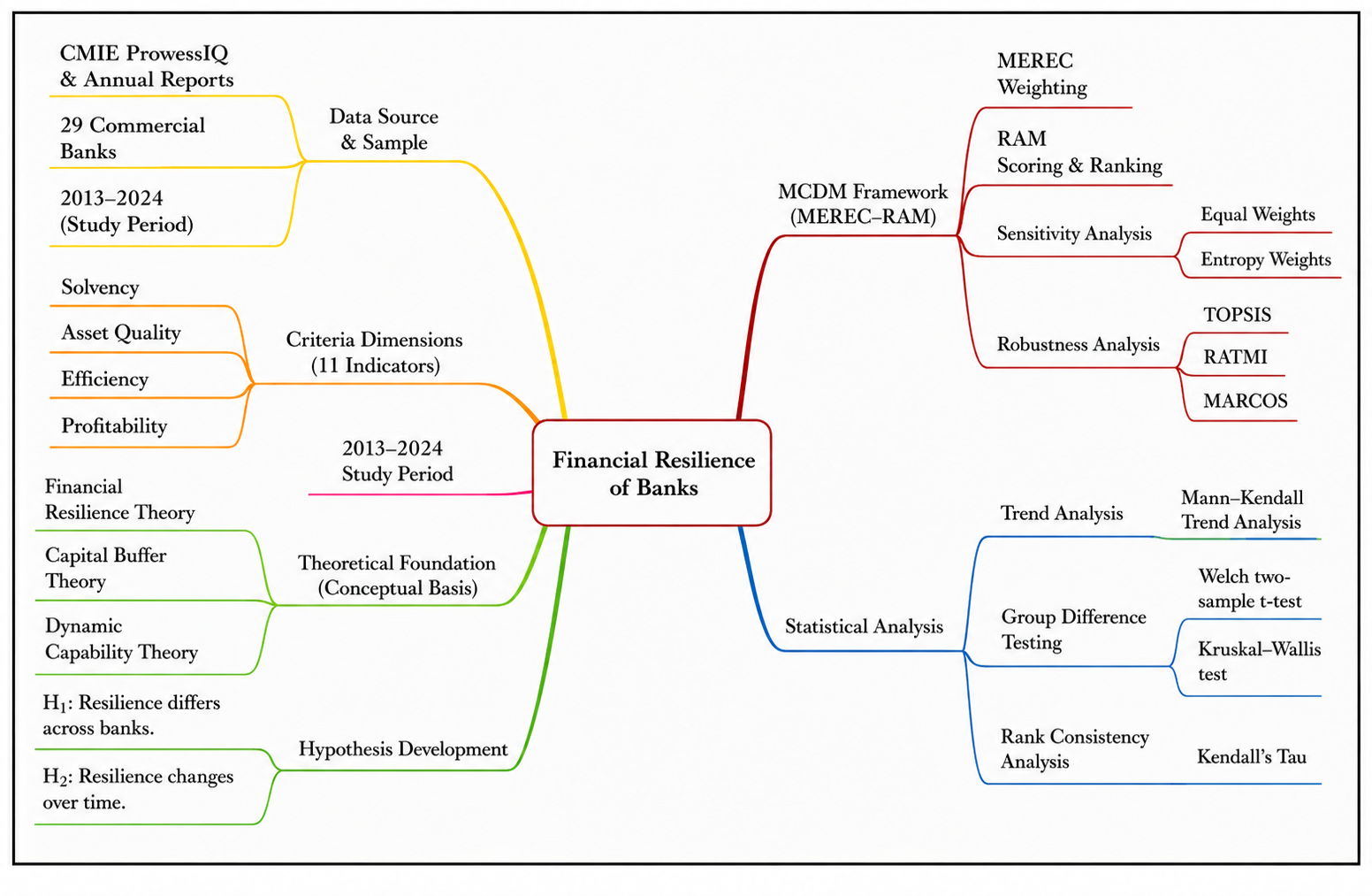
Assessing financial resilience in the banking sector requires an integrated framework that captures both cross-sectional strength and long-term resilience dynamics. In this study, financial resilience of Indian commercial banks during the period 2013–2024 is assessed by using a hybrid MCDM and non-parametric trend analysis approach. Eleven financial indicators covering solvency, asset quality, efficiency, and profitability are included in a composite resilience framework, and criterion weights were objectively determined using the MEREC method. The technique RAM is used to calculate annual composite resilience scores and ranks the 29 commercial banks. A Mann–Kendall time-series analysis is also applied to the final RAM scores to analyze long-term monotonic trends in bank-level and sector-wide resilience. The results showed that RAM scores are tightly clustered across banks, suggesting structural convergence in resilience levels. However, Kruskal-Wallis non-parametric test showed statistically significant differences in the banks’ relative financial resilience across the study period. The MEREC-RAM ranking result showed Kotak Mahindra Bank Ltd. and Tamilnad Mercantile Bank Ltd. consistently appeared among top at the rankings. While, the Mann-Kendall trend test revealed significant improvement in the resilience of CSB Bank Ltd. and Bank of Maharashtra over the study period. Overall, combining year-wise relative rankings and monotonic resilience dynamics enables a comprehensive assessment of the stability of the Indian banking sector, which can offer key insights for regulators, policymakers, and bank management in strengthening the long-term financial resilience of the sector.
References
1. F. Salignac, A. Marjolin, R. Reeve, and K. Muir, “Conceptualizing and measuring financial resilience,” Social Indicators Research, vol. 145, no. 1, pp. 17–38, 2019, doi:https://doi.org/10.1007/s11205-019-02100-4. DOI: https://doi.org/10.1007/s11205-019-02100-4
2. F. Salignac, J. Hanoteau, and I. Ramia, “Financial resilience: a way forward towards economic development in developing countries,” Social Indicators Research, vol. 160, no. 1, pp. 1–33, 2022, doi:https://doi.org/10.1007/s11205-021-02793-6. DOI: https://doi.org/10.1007/s11205-021-02793-6
3. S. K. Nkundabanyanga, E. Mugumya, I. Nalukenge, M. Muhwezi, and G. M. Najjemba, “Firm characteristics, innovation, financial resilience and survival of financial institutions,” Journal of Accounting in Emerging Economies, vol. 10, no. 1, pp. 48–73, 2020, doi:https://doi.org/10.1108/JAEE-08-2018-0094. DOI: https://doi.org/10.1108/JAEE-08-2018-0094
4. F. S. Hamid, Y. J. Loke, and P. N. Chin, “Determinants of financial resilience: insights from an emerging economy,” Journal of social and economic development, vol. 25, no. 2, pp. 479–499, 2023, doi:https://doi.org/10.1007/s40847-023-00239-y. DOI: https://doi.org/10.1007/s40847-023-00239-y
5. A. A. Tinta, I. M. Ou´edraogo, and R. M. Al-Hassan, “The micro determinants of financial inclusion and financial resilience in africa,” African Development Review, vol. 34, no. 2, pp. 293–306, 2022, doi:https://doi.org/10.1111/1467-8268.12636. DOI: https://doi.org/10.1111/1467-8268.12636
6. A. Das and S. Ghosh, “Financial deregulation and profit efficiency: A nonparametric analysis of indian banks,” Journal of Economics and Business, vol. 61, no. 6, pp. 509–528, 2009, doi:https://doi.org/10.1016/j.jeconbus.2009.07.003. DOI: https://doi.org/10.1016/j.jeconbus.2009.07.003
7. S. Kumar and R. Gulati, “Did the global financial crisis alter the competitive conditions in the indian banking industry?” Applied Economics Letters, vol. 26, no. 10, pp. 857–865, 2019, doi:https://doi.org/10.1080/13504851.2018.1502865. DOI: https://doi.org/10.1080/13504851.2018.1502865
8. N. Mohan and M. Irfan, “Applying ai & topsismcdm tool in evaluating top five private indian bank performances,” in Applications of Block Chain technology and Artificial Intelligence: Lead-ins in Banking, Finance, and Capital Market. Springer, 2024, pp. 291–303, doi:https://doi.org/10.1007/978-3-031-47324-1_15. DOI: https://doi.org/10.1007/978-3-031-47324-1_15
9. G. Caprio, Banking on crises: expensive lessons from recent financial crises. World Bank, Development Research Group, Finance, 1998, no. 1979.
10. A. Bhattacharyya, C. K. Lovell, and P. Sahay, “The impact of liberalization on the productive efficiency of indian commercial banks,” European Journal of operational research, vol. 98, no. 2, pp. 332–345, 1997, doi:https://doi.org/10.1016/S0377-2217(96)00351-7. DOI: https://doi.org/10.1016/S0377-2217(96)00351-7
11. S. Akhtar, S. N. Azmi, P. A. Khan, A. A. Jan, and Z. Ansari, “Unveiling the financial landscape: analyzing profitability, productivity, and efficiency of banks in an emerging economy using the camels framework and panel analysis,” Cogent Business & Management, vol. 11, no. 1, p. 2399747, 2024, doi:https://doi.org/10.1080/23311975.2024.2399747. DOI: https://doi.org/10.1080/23311975.2024.2399747
12. A. Sharma, “Incomplete reform or opportunity: the role of the banking sector in the credit transmission mechanism in india,” Journal of Economic Policy Reform, vol. 11, no. 4, pp. 273–288, 2008, doi:https://doi.org/10.1080/17487870802567315. DOI: https://doi.org/10.1080/17487870802567315
13. B. Eichengreen and P. Gupta, “The financial crisis and indian banks: survival of the fittest?” Journal of International Money and Finance, vol. 39, pp. 138–152, 2013, doi:https://doi.org/10.1016/j.jimonfin.2013.06.022. DOI: https://doi.org/10.1016/j.jimonfin.2013.06.022
14. H. Fujii, S. Managi, and R. Matousek, “Indian bank efficiency and productivity changes with undesirable outputs: A disaggregated approach,” Journal of banking & finance, vol. 38, pp. 41–50, 2014, doi:https://doi.org/10.1016/j.jbankfin.2013.09.022. DOI: https://doi.org/10.1016/j.jbankfin.2013.09.022
15. K. Srinivasan, K. Ramesh, K. Gunasekaran, and K. Sivasubramanian, “Reforms in indian banking sector: a paradigm shift in growth and financial inclusion in india,” in Technology-Driven Business Innovation: Unleashing the Digital Advantage, Volume 1. Springer, 2024, pp. 433– 439, doi:https://doi.org/10.1007/978-3-031-51997-0_36. DOI: https://doi.org/10.1007/978-3-031-51997-0_36
16. N. Shikha and I. Kapsis, “Bank crisis management and resolution after svb and credit suisse: Perspectives from india and the european union,” International Insolvency Review, vol. 33, no. 1, pp. 55–88, 2024, doi:https://doi.org/10.1002/iir.1516. DOI: https://doi.org/10.1002/iir.1516
17. A. Nasim, G. Downing, and M. A. Nasir, “The role of uncertainty, regulatory and economic environment and quantitative tightening in banks’ performance,” International Journal of Finance & Economics, vol. 31, no. 1, pp. 46–69, 2026, doi:https://doi.org/10.1002/ijfe.3128. DOI: https://doi.org/10.1002/ijfe.3128
18. K. D. Hanumantu, V. Worlikar, and S. Narayanaswami, “The punjab national bank scam: Ethics versus robust processes,” Journal of Public Affairs, vol. 19, no. 4, p. e1952, 2019, doi:https://doi.org/10.1002/pa.1952. DOI: https://doi.org/10.1002/pa.1952
19. J. Truby, R. Brown, and A. Dahdal, “Banking on ai: mandating a proactive approach to ai regulation in the financial sector,” Law and Financial Markets Review, vol. 14, no. 2, pp. 110–120, 2020, doi:https://doi.org/10.1080/17521440.2020.1760454. DOI: https://doi.org/10.1080/17521440.2020.1760454
20. A. Sotoudeh-Anvari, “Root assessment method (ram): A novel multi-criteria decision making method and its applications in sustainability challenges,” Journal of Cleaner Production, vol. 423, p. 138695, 2023, doi:https://doi.org/10.1016/j.jclepro.2023.138695. DOI: https://doi.org/10.1016/j.jclepro.2023.138695
21. ——, “Root assessment method (ram) under neutrosophic environment,” in Neutrosophic Paradigms: Advancements in Decision Making and Statistical Analysis: Neutrosophic Principles for Handling Uncertainty. Springer, 2025, pp. 123–138, doi:https://doi.org/10.1007/978-3-031-78505-46. DOI: https://doi.org/10.1007/978-3-031-78505-4_6
22. M. Keshavarz-Ghorabaee, M. Amiri, E. K. Zavadskas, Z. Turskis, and J. Antucheviciene, “Determination of objective weights using a new method based on the removal effects of criteria (merec),” Symmetry, vol. 13, no. 4, p. 525, 2021, doi:https://doi.org/10.3390/sym13040525. DOI: https://doi.org/10.3390/sym13040525
23. M. S. Tahir and D. W. Richards, “A systematic literature review of financial resilience: antecedents, consequences and future research agenda,” Journal of Financial Regulation and Compliance, 2025, doi:https://doi.org/10.1108/JFRC-10-2024-0204. DOI: https://doi.org/10.1108/JFRC-10-2024-0204
24. L. Klapper and A. Lusardi, “Financial literacy and financial resilience: Evidence from around the world,” Financial Management, vol. 49, no. 3, pp. 589–614, 2020, doi:https://doi.org/10.1111/fima.12283. DOI: https://doi.org/10.1111/fima.12283
25. A. Lusardi, A. Hasler, and P. J. Yakoboski, “Building up financial literacy and financial resilience,” Mind & Society, vol. 20, no. 2, pp. 181–187, 2021, doi:https://doi.org/10.1007/s11299-020-00246-0. DOI: https://doi.org/10.1007/s11299-020-00246-0
26. C. Jansson, “Financial resilience: the role of financial balance, profitability, and ownership,” in The Resilience Framework: Organizing for Sustained Viability. Springer, 2017, pp. 111–131, doi:https://doi.org/10.1007/978-981-10-5314-6_7. DOI: https://doi.org/10.1007/978-981-10-5314-6_7
27. A. Sreenivasan and M. Suresh, “Readiness of financial resilience in start-ups,” Journal of Safety Science and Resilience, vol. 4, no. 3, pp. 241–252, 2023, doi:https://doi.org/10.1016/j.jnlssr.2023.02.004. DOI: https://doi.org/10.1016/j.jnlssr.2023.02.004
28. R. L. Clark and O. S. Mitchell, “Americans’ financial resilience during the pandemic,” Financial Planning Review, vol. 5, no. 2-3, p. e1140, 2022, doi:https://doi.org/10.1002/cfp2.1140. DOI: https://doi.org/10.1002/cfp2.1140
29. G. M. Markman and M. Venzin, “Resilience: Lessons from banks that have braved the economic crisis—and from those that have not,” International Business Review, vol. 23, no. 6, pp. 1096–1107, 2014, doi:https://doi.org/10.1016/j.ibusrev.2014.06.013. DOI: https://doi.org/10.1016/j.ibusrev.2014.06.013
30. G. O. Danisman, E. Demir, and A. Zaremba, “Financial resilience to the covid-19 pandemic: The role of banking market structure,” Applied Economics, vol. 53, no. 39, pp. 4481–4504, 2021, doi:https://doi.org/10.1080/00036846.2021.1904118. DOI: https://doi.org/10.1080/00036846.2021.1904118
31. T. Papadimitriou, P. Gogas, and A. Agrapetidou, “The resilience of the us banking system,” International Journal of Finance & Economics, vol. 27, no. 3, pp. 2819–2835, 2022, doi:https://doi.org/10.1002/ijfe.2300. DOI: https://doi.org/10.1002/ijfe.2300
32. C. Cant´u, R. Lobato, C. L´opez, and F. L´opez-Gallo, “A loan-level analysis of financial resilience in mexico,” Journal of Banking & Finance, vol. 135, p. 105951, 2022, doi:https://doi.org/10.1016/j.jbankfin.2020.105951. DOI: https://doi.org/10.1016/j.jbankfin.2020.105951
33. S. Alam, S. K. Das, U. R. Dipa, and S. Z. Hossain, “Predicting financial distress through ownership pattern: dynamics of financial resilience of bangladesh,” Future Business Journal, vol. 10, no. 1, p. 91, 2024, doi:https://doi.org/10.1186/s43093-024-00379-5. DOI: https://doi.org/10.1186/s43093-024-00379-5
34. E. Daadmehr, “Workplace sustainability or financial resilience? composite-financial resilience index,” Risk management, vol. 26, no. 2, p. 7, 2024, doi:https://doi.org/10.1057/s41283-023-00139-9. DOI: https://doi.org/10.1057/s41283-023-00139-9
35. Y. Chen and C. Sun, “A new method for measuring financial resilience,” Economics Letters, vol. 242, p. 111883, 2024, doi:https://doi.org/10.1016/j.econlet.2024.111883. DOI: https://doi.org/10.1016/j.econlet.2024.111883
36. E. K. Zavadskas, Z. Turskis, J. Antucheviciene, and A. Zakarevicius, “Optimization of weighted aggregated sum product assessment,” Elektronika ir elektrotechnika, vol. 122, no. 6, pp. 3–6, 2012, doi:https://doi.org/10.5755/j01.eee.122.6.1810. DOI: https://doi.org/10.5755/j01.eee.122.6.1810
37. S. Gupta, M. Mathew, S. Gupta, and V. Dawar, “Benchmarking the private sector banks in india using mcdm approach,” Journal of Public Affairs, vol. 21, no. 2, p. e2409, 2021, doi:https://doi.org/10.1002/pa.2409. DOI: https://doi.org/10.1002/pa.2409
38. S. Gupta, M. Mathew, G. Syal, and J. Jain, “A hybrid mcdm approach for evaluating the financial performance of public sector banks in india,” International Journal of Business Excellence, vol. 24, no. 4, pp. 481–501, 2021, doi:https://doi.org/10.1504/IJBEX.2021.117648. DOI: https://doi.org/10.1504/IJBEX.2021.117648
39. P.-H. Nguyen, J.-F. Tsai, Y.-C. Hu, and G. V. Ajay Kumar, “A hybrid method of mcdm for evaluating financial performance of vietnamese commercial banks under covid-19 impacts,” in Shifting economic, financial and banking paradigm: New systems to encounter COVID-19. Springer, 2021, pp. 23–45, doi:https://doi.org/10.1007/978-3-030-79610-5_2. DOI: https://doi.org/10.1007/978-3-030-79610-5_2
40. A. Karbassi Yazdi, C. Spulbar, T. Hanne, and R. Birau, “Ranking performance indicators related to banking by using hybrid multicriteria methods in an uncertain environment: A case study for iran under covid-19 conditions,” Systems Science & Control Engineering, vol. 10, no. 1, pp. 166–180, 2022, doi:https://doi.org/10.1080/21642583.2022.2052996. DOI: https://doi.org/10.1080/21642583.2022.2052996
41. U. ¨Unl¨u, N. Yal¸cın, and N. Av¸sarlıgil, “Analysis of efficiency and productivity of commercial banks in turkey pre-and during covid-19 with an integrated mcdm approach,” Mathematics, vol. 10, no. 13, p. 2300, 2022, doi:https://doi.org/10.3390/math10132300. DOI: https://doi.org/10.3390/math10132300
42. Y. A. ¨Unvan and C. Ergen¸c, “Financial performance analysis with the fuzzy copras and entropy-copras approaches,” Computational Economics, vol. 59, no. 4, pp. 1577–1605, 2022, doi:https://doi.org/10.1007/s10614-021-10143-4. DOI: https://doi.org/10.1007/s10614-021-10143-4
43. P. Wanke, M. A. K. Azad, A. K. Yazdi, F. R. Birau, and C. M. Spulbar, “Revisiting camels rating system and the performance of asean banks: a comprehensive mcdm/z-numbers approach,” IEEE Access, vol. 10, pp. 54 098–54 109, 2022, doi:https://doi.org/10.1109/ACCESS.2022.3171339. DOI: https://doi.org/10.1109/ACCESS.2022.3171339
44. H. R. Sama, S. V. K. Kosuri, and S. Kalvakolanu, “Evaluating and ranking the indian private sector banks—a multi-criteria decision-making approach,” Journal of Public Affairs, vol. 22, no. 2, p. e2419, 2022, doi:https://doi.org/10.1002/pa.2419. DOI: https://doi.org/10.1002/pa.2419
45. P. Kumar and D. Sharma, “Prioritising the financial performance of indian private sector banks by a hybrid mcdm approach,” International Journal of Process Management and Benchmarking, vol. 16, no. 4, pp. 490–511, 2024, doi:https://doi.org/10.1504/IJPMB.2024.137145. DOI: https://doi.org/10.1504/IJPMB.2024.137145
46. ¨O. Karada˘g Ak, A. Hazar, and S¸. Babu¸scu, “Evaluation of the financial performance of development and investment banks with entropy-based aras method,” Macroeconomics and Finance in Emerging Market Economies, vol. 18, no. 2, pp. 441–461, 2025, doi:https://doi.org/10.1080/17520843.2022.2035523. DOI: https://doi.org/10.1080/17520843.2022.2035523
47. ¨O. I¸sık, M. Shabir, G. Demir, A. Puska, and D. Pamucar, “A hybrid framework for assessing pakistani commercial bank performance using multi-criteria decision-making,” Financial Innovation, vol. 11, no. 1, p. 38, 2025, doi:https://doi.org/10.1186/s40854-024-00728-x. DOI: https://doi.org/10.1186/s40854-024-00728-x
48. J. Zahedi, M. Salehi, and M. Moradi, “Identifying and classifying the contributing factors to financial resilience,” foresight, vol. 24, no. 2, pp. 177–194, 2022, doi:https://doi.org/10.1108/FS-10-2020-0102. DOI: https://doi.org/10.1108/FS-10-2020-0102
49. Z. Liu, J.-K. Chen, and J. J. Xiao, “Financial resilience: a scoping review, conceptual synthesis and theoretical framework,” International Journal of Bank Marketing, vol. 43, no. 7, pp. 1541–1576, 2025, doi:https://doi.org/10.1108/IJBM-12-2024-0735. DOI: https://doi.org/10.1108/IJBM-12-2024-0735
50. T. Jokipii and A. Milne, “Bank capital buffer and risk adjustment decisions,” Journal of Financial Stability, vol. 7, no. 3, pp. 165–178, 2011, doi:https://doi.org/10.1016/j.jfs.2010.02.002. DOI: https://doi.org/10.1016/j.jfs.2010.02.002
51. D. Corbae and P. D’Erasmo, “Capital buffers in a quantitative model of banking industry dynamics,” Econometrica, vol. 89, no. 6, pp. 2975–3023, 2021, doi:https://doi.org/10.3982/ECTA16930. DOI: https://doi.org/10.3982/ECTA16930
52. C. D. Carroll, R. E. Hall, and S. P. Zeldes, “The bufferstock theory of saving: Some macroeconomic evidence,” Brookings papers on economic activity, vol. 1992, no. 2, pp. 61–156, 1992, doi:https://doi.org/10.2307/2534582. DOI: https://doi.org/10.2307/2534582
53. D. J. Teece, G. Pisano, and A. Shuen, “Dynamic capabilities and strategic management,” Strategic management journal, vol. 18, no. 7, pp. 509–533, 1997, doi:https://doi.org/10.1002/(SICI)1097-0266(199708). DOI: https://doi.org/10.1002/(SICI)1097-0266(199708)18:7<509::AID-SMJ882>3.0.CO;2-Z
54. M. M. H. Chowdhury and M. Quaddus, “Supply chain resilience: conceptualization and scale development using dynamic capability theory,” International journal of production economics, vol. 188, pp. 185–204, 2017, doi:https://doi.org/10.1016/j.ijpe.2017.03.020. DOI: https://doi.org/10.1016/j.ijpe.2017.03.020
55. M. Doumpos and C. Zopounidis, “A multicriteria decision support system for bank rating,” Decision support systems, vol. 50, no. 1, pp. 55–63, 2010, doi:https://doi.org/10.1016/j.dss.2010.07.002. DOI: https://doi.org/10.1016/j.dss.2010.07.002
56. R. Gineviˇcius and A. Podviezko, “The evaluation of financial stability and soundness of lithuanian banks,” Economic research-Ekonomska istraˇzivanja, vol. 26, no. 2, pp. 191–208, 2013, doi:https://doi.org/10.1080/1331677X.2013.11517616. DOI: https://doi.org/10.1080/1331677X.2013.11517616
57. B. Gavurova, J. Belas, K. Kocisova, and T. Kliestik, “Comparison of selected methods for performance evaluation of czech and slovak commercial banks,” Journal of Business Economics and Management, vol. 18, no. 5, pp. 852–876, 2017, doi:https://doi.org/10.3846/16111699.2017.1371637. DOI: https://doi.org/10.3846/16111699.2017.1371637
58. M. Dash, “A model for bank performance measurement integrating multivariate factor structure with multi-criteria promethee methodology,” Asian Journal of Finance & Accounting, vol. 9, no. 1, pp. 310–332, 2017, doi:https://doi.org/10.5296/ajfa.v9i1.11073. DOI: https://doi.org/10.5296/ajfa.v9i1.11073
59. C. Ayadurai and R. Eskandari, “Bank soundness: a pls-sem approach,” in Partial least squares structural equation modeling: Recent advances in banking and finance. Springer, 2018, pp. 31–52, doi:https://doi.org/10.1007/978-3-319-71691-6_2. DOI: https://doi.org/10.1007/978-3-319-71691-6_2
60. I. Marjanovi´c and ˇZ. Popovi´c, “Mcdm approach for assessment of financial performance of serbian banks,” in Business performance and financial institutions in Europe: Business models and value creation across European industries. Springer, 2020, pp. 71–90, doi:https://doi.org/10.1007/978-3-030-57517-5_5. DOI: https://doi.org/10.1007/978-3-030-57517-5_5
61. J. Reig-Mullor, J. M. Brotons-Martinez, and M. E. Sansalvador-Selles, “A novel approach to improve the bank ranking process: an empirical study in spain,” Journal of Intelligent & Fuzzy Systems, vol. 38, no. 5, pp. 5323–5331, 2020, doi:https://doi.org/10.3233/JIFS-179626. DOI: https://doi.org/10.3233/JIFS-179626
62. M. A. Bushashe, “Determinants of private banks performance in ethiopia: A partial least square structural equation model analysis (pls-sem),” Cogent Business & Management, vol. 10, no. 1, p. 2174246, 2023, doi:https://doi.org/10.1080/23311975.2023.2174246. DOI: https://doi.org/10.1080/23311975.2023.2174246
63. V. Sharma, M. Gupta, and K. Jangir, “Exploring the impact of risk factors on profitability in commercial banking in india: a pls-sem analysis approach,” 2024, doi:https://doi.org/10.1108/978-1-83753-734-120241007. DOI: https://doi.org/10.1108/978-1-83753-734-120241007
64. S. S. Goswami, S. K. Mohanty, and D. K. Behera, “Selection of a green renewable energy source in india with the help of merec integrated piv mcdm tool,” Materials today: proceedings, vol. 52, pp. 1153–1160, 2022, doi:https://doi.org/10.1016/j.matpr.2021.11.019. DOI: https://doi.org/10.1016/j.matpr.2021.11.019
65. S. Kumar, P. Ahijith Kumar, K. Bharati, L. Patnaik, S. Ranjan Maity, and M. Lepicka, “Coating material selection for bulk metal forming dies: A merec-integrated approach with multiple mcdm methods,” International Journal on Interactive Design and Manufacturing (IJI-DeM), vol. 19, no. 6, pp. 4055–4070, 2025, doi:https://doi.org/10.1007/s12008-024-01983-z. DOI: https://doi.org/10.1007/s12008-024-01983-z
66. I. M. Hezam, A. M. Ali, K. Sallam, I. A. Hameed, A. Foul, and M. Abdel-Basset, “An extension of root assessment method (ram) under spherical fuzzy framework for optimal selection of electricity production technologies toward sustainability: a case study,” International Journal of Energy Research, vol. 2024, no. 1, p. 7985867, 2024, doi:https://doi.org/10.1155/2024/7985867. DOI: https://doi.org/10.1155/2024/7985867
67. T. Van Dua, D. D. Trung, N. T. P. Giang, and D. Van Duc, “Comparison of two methods: Ram and aroman,” in International Conference on Sustainability and Emerging Technologies for Smart Manufacturing. Springer, 2024, pp. 727–735, doi:https://doi.org/10.1007/978-981-97-7083-0_73. DOI: https://doi.org/10.1007/978-981-97-7083-0_73
68. A. Shekhovtsov, M. Gandorc, R. Pawlakb, and W. Sa labuna, “A novel rancom-ram-based framework for city assessment based on cost of living,” Procedia Computer Science, vol. 270, pp. 5776–5786, 2025, doi:https://doi.org/10.1016/j.procs.2025.10.046. DOI: https://doi.org/10.1016/j.procs.2025.10.046
Published
Issue
Section
License
Copyright (c) 2026 The Authors. Published by BenchCouncil Press on Behalf of International Open Benchmark Council

This work is licensed under a Creative Commons Attribution-NonCommercial-NoDerivatives 4.0 International License.