Mapping the Intellectual Landscape of Blockchain in the Banking Industry: A Hybrid Bibliometric and Systematic Review (2015–2025)
DOI:
https://doi.org/10.66834/xqpw3878Keywords:
Blockchain Technology; Banking Sector; Bibliometric Analysis; Systematic Content Review; Financial Technology; Decentralized FinanceAbstract
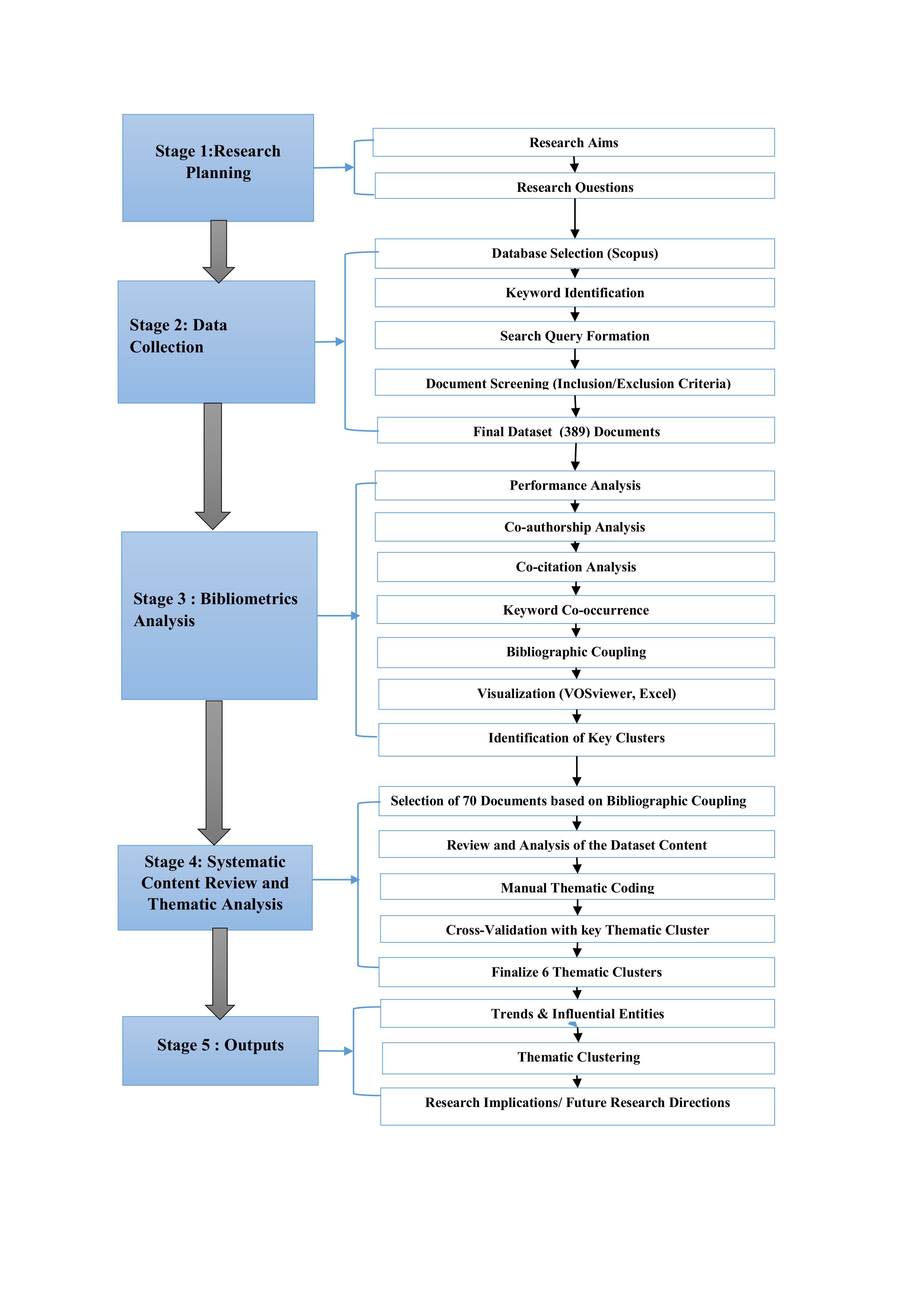
The advent of blockchain technology has introduced new alternatives to traditional banking systems, providing a decentralized, secure, and transparent framework. However, its adoption is still complex and uneven for many reasons. This study provides a comprehensive mapping of the intellectual trajectory, thematic structure, and development of blockchain technology research in the banking sector. Using a hybrid literature review methodology that combines bibliometric analysis and systematic content review, the study analyzes 389 peer-reviewed publications retrieved from Scopus (2015–May 2025). VOSviewer was employed to conduct performance analysis and science mapping, including co-authorship, co-citation, keyword co-occurrence, and bibliographic coupling analyses. In parallel, qualitative thematic analysis identified six clusters: (1) blockchain in banking and financial intermediation to enhance operational efficiency, (2) decentralized finance and cryptocurrencies, (3) integration of blockchain with other digital innovations, (4) trust-related dimensions, (5) institutional and regulatory aspects, and (6) strategies for modernizing banking business models. The findings reveal a steady rise in research output, regional disparities in collaboration, and thematic evolution from early conceptualization to recent signs of diversification of applied research. By integrating quantitative and qualitative insights, this study highlights key research gaps, offers directions for future work, and provides guidance for academics, practitioners, and policymakers on the transformative potential and challenges of blockchain in banking.
References
1. A. Kumari and C. Devi, “The impact of fintech and blockchain technologies on banking and financial services,” Technology Innovation Management Review, vol. 12, no. 1/2, p. 22010204, 2022, doi:https://doi.org/10.22215/timreview/1481. DOI: https://doi.org/10.22215/timreview/1481
2. S. Nakamoto, “Bitcoin: A peer-to-peer electronic cash system,” 2008, social Science Research Network, Rochester, NY: 3440802. doi:https://doi.org/10.2139/ssrn.3440802. DOI: https://doi.org/10.2139/ssrn.3440802
3. T. Philip, R. G. Brown, and Y. Danny, “Blockchain technology in finance,” Computer, vol. 50, no. 9, pp. 14–17, 2017, doi:https://doi.org/10.1109/mc.2017.3571047. DOI: https://doi.org/10.1109/MC.2017.3571047
4. S. Sarmah, “Understanding blockchain technology,” American Journal of Computer Science and Technology, vol. 8, no. 2, pp. 23–29, Aug. 2018, doi:https://doi.org/10.5923/j.computer.20180802.02.
5. A. T. Sherman, F. Javani, H. Zhang, and E. Golaszewski, “On the origins and variations of blockchain technologies,” IEEE Security & Privacy, vol. 17, no. 1, pp. 72–77, 2019, doi:https://doi.org/10.1109/MSEC.2019.2893730. DOI: https://doi.org/10.1109/MSEC.2019.2893730
6. A. A. Monrat, O. Schelén, and K. Andersson, “A survey of blockchain from the perspectives of applications, challenges, and opportunities,” IEEE Access, vol. 7, pp. 117 134–117 151, 2019, doi:https://doi.org/10.1109/ACCESS.2019.2936094. DOI: https://doi.org/10.1109/ACCESS.2019.2936094
7. J. Li and M. Kassem, “Applications of distributed ledger technology (dlt) and blockchain-enabled smart contracts in construction,” Automation in Construction, vol. 132, p.103955, 2021, doi:https://doi.org/10.1016/j.autcon.2021.103955. DOI: https://doi.org/10.1016/j.autcon.2021.103955
8. M. S. Ali, M. Vecchio, M. Pincheira, K. Dolui, F. Antonelli, and M. H. Rehmani, “Applications of blockchains in the internet of things: A comprehensive survey,” IEEE Communications Surveys & Tutorials, vol. 21, no. 2, pp. 1676–1717, 2019, doi:https://doi.org/10.1109/COMST.2018.2886932. DOI: https://doi.org/10.1109/COMST.2018.2886932
9. M. H. Joo, Y. Nishikawa, and K. Dandapani, “Cryptocurrency, a successful application of blockchain technology,” Managerial Finance, vol. 46, no. 6, pp. 715–733, 2019, doi:https://doi.org/10.1108/MF-09-2018-0451. DOI: https://doi.org/10.1108/MF-09-2018-0451
10. T. K. Mackey et al., “‘fit-for-purpose?’–challenges and opportunities for applications of blockchain technology in the future of healthcare,” BMC Medicine, vol. 17, no. 1, p. 68, 2019, doi:https://doi.org/10.1186/s12916-019-1296-7. DOI: https://doi.org/10.1186/s12916-019-1296-7
11. C. Laroiya, D. Saxena, and C. Komalavalli, “Chapter 9-applications of blockchain technology,” in Handbook of Research on Blockchain Technology, S. Krishnan, V. E. Balas, E. G. Julie, Y. H. Robinson, S. Balaji, and R. Kumar, Eds. Academic Press, 2020, pp. 213–243, doi:https://doi.org/10.1016/B978-0-12-819816-2.00009-5. DOI: https://doi.org/10.1016/B978-0-12-819816-2.00009-5
12. A. Pal, C. K. Tiwari, and A. Behl, “Blockchain technology in financial services: a comprehensive review of the literature,” Journal of Global Operations and Strategic Sourcing, vol. 14, no. 1, pp. 61–80, Mar. 2021, doi:https://doi.org/10.1108/JGOSS-07-2020-0039. DOI: https://doi.org/10.1108/JGOSS-07-2020-0039
13. N. Hackius and M. Petersen, “Blockchain in logistics and supply chain: Trick or treat?” in Proceedings of the Hamburg International Conference of Logistics (HICL), Vol. 23, W. Kersten, T. Blecker, and C. M. Ringle, Eds. Berlin: epubli GmbH, 2017, pp. 3–18, doi:https://doi.org/10.15480/882.1444.
14. M. Hernes, A. Rot, and D. Jelonek, Eds., Towards Industry 4.0-Current Challenges in Information Systems, 1st ed., ser. Studies in Computational Intelligence. Cham, Switzerland: Springer International Publishing, 2020, vol. 887, doi:https://doi.org/10.1007/978-3-030-40417-8. DOI: https://doi.org/10.1007/978-3-030-40417-8
15. L. Cocco, A. Pinna, and M. Marchesi, “Banking on blockchain: Costs savings thanks to the blockchain technology,” Future Internet, vol. 9, no. 3, p. 25, Sep. 2017, doi:https://doi.org/10.3390/fi9030025. DOI: https://doi.org/10.3390/fi9030025
16. W. L. Harris and J. Wonglimpiyarat, “Blockchain platform and future bank competition,” Foresight, vol. 21, no. 6, pp. 625–639, Jul. 2019, doi:https://doi.org/10.1108/FS-12-2018-0113. DOI: https://doi.org/10.1108/FS-12-2018-0113
17. H. S. Ali, F. Jia, Z. Lou, and J. Xie, “Effect of blockchain technology initiatives on firms’ market value,” Financial Innovation, vol. 9, no. 1, pp. 1–35, 2023, doi:https://doi.org/10.1186/s40854-023-00456-8. DOI: https://doi.org/10.1186/s40854-023-00456-8
18. S. M. M. Rahman et al., “Blockchain in the banking industry: Unravelling thematic drivers and proposing a technological framework through systematic review with bibliographic network mapping,” IET Blockchain, vol. 5, no. 1, p. e12093, 2025, doi:https://doi.org/10.1049/blc2.12093. DOI: https://doi.org/10.1049/blc2.12093
19. A. Ali, “Decentralized finance (defi) and its impact on traditional banking systems: Opportunities, challenges, and future directions,” Social Science Research Network, Rochester, NY, Aug. 2024, sSRN ID: 4942313. doi:https://doi.org/10.2139/ssrn.4942313. DOI: https://doi.org/10.2139/ssrn.4942313
20. A. Alamsyah, G. N. W. Kusuma, and D. P. Ramadhani, “A review on decentralized finance ecosystems,” Future Internet, vol. 16, no. 3, p. 76, Mar. 2024, doi:https://doi.org/10.3390/fi16030076. DOI: https://doi.org/10.3390/fi16030076
21. D. Tapscott and A. Tapscott, Blockchain Revolution: How the Technology Behind Bitcoin Is Changing Money, Business, and the World. Penguin Publishing Group, 2016.
22. T. Ahram, A. Sargolzaei, S. Sargolzaei, J. Daniels, and B. Amaba, “Blockchain technology innovations,” in 2017 IEEE Technology & Engineering Management Conference (TEMSCON), Jun. 2017, pp. 137–141, doi:https://doi.org/10.1109/TEMSCON.2017.7998367. DOI: https://doi.org/10.1109/TEMSCON.2017.7998367
23. V. K. Vemuri, “Blockchain: a practical guide to developing business, law, and technology solutions,” Journal of Information Technology Case and Application Research, 2018, accessed: Jun. 18, 2025. doi:https://doi.org/10.1080/15228053.2019.1588546. DOI: https://doi.org/10.1080/15228053.2019.1588546
24. R. Zhang, R. Xue, and L. Liu, “Security and privacy on blockchain,” ACM Computing Surveys, vol. 52, no. 3, pp. 1–34, May 2020, doi:https://doi.org/10.1145/3316481. DOI: https://doi.org/10.1145/3316481
25. E. O. M. A. D. B. A. O. L. C. E. U. A. A. Bello, D. A. Oduro and N. Okika., “Enhancing know your customer (kyc) and anti-money laundering (aml) compliance using blockchain: A business analysis approach,” Iconic Research And Engineering Journals, 8(9):297–305, 2025, [Online]. [Online]. Available:https://www.irejournals.com/paper-details/1707440
26. Y. Guo and C. Liang, “Blockchain application and outlook in the banking industry,” Financial Innovation, vol. 2, no. 1, p. 24, Dec. 2016, doi:https://doi.org/10.1186/s40854-016-0034-9. DOI: https://doi.org/10.1186/s40854-016-0034-9
27. T.-G. Budisteanu, “Blockchain and the banking sector: Benefits, challenges and perspectives,” Journal of Service Science (JSS), vol. 13, no. 03, pp. 288–300, 2025, doi:https://doi.org/10.4236/jss.2025.133019. DOI: https://doi.org/10.4236/jss.2025.133019
28. R. Mishra, R. K. Singh, S. Kumar, S. K. Mangla, and V. Kumar, “Critical success factors of blockchain technology adoption for sustainable and resilient operations in the banking industry during an uncertain business environment,” Electronic Commerce Research, vol. 25, no. 1, pp. 595–629, Feb. 2025, doi:https://doi.org/10.1007/s10660-023-09707-3. DOI: https://doi.org/10.1007/s10660-023-09707-3
29. H. Taherdoost, “A critical review of blockchain acceptance models—blockchain technology adoption frameworks and applications,” Computers, vol. 11, no. 2, p. 24, Feb. 2022, doi:https://doi.org/10.3390/computers11020024. DOI: https://doi.org/10.3390/computers11020024
30. J. Paul and A. R. Criado, “The art of writing literature review: What do we know and what do we need to know?” International Business Review, vol. 29, no. 4, p. 101717, Aug 2020, doi:https://doi.org/10.1016/j.ibusrev.2020.101717. DOI: https://doi.org/10.1016/j.ibusrev.2020.101717
31. J. Pritchard, “Statistical-bibliography or bibliometrics?” Journal of Documentation, vol. 25, no. 4, pp. 348–349, 1969. DOI: https://doi.org/10.1108/eb026482
32. L. Haggarty, “What is content analysis?” Medical Teacher, vol. 18, no. 2, pp. 99–101, Jan 1996, doi:https://doi.org/10.3109/01421599609034141. DOI: https://doi.org/10.3109/01421599609034141
33. Y. Feng, Q. Zhu, and K. H. Lai, “Corporate social responsibility for supply chain management: A literature review and bibliometric analysis,” Journal of Cleaner Production, vol. 158, pp. 296–307, Aug 2017, doi:https://doi.org/10.1016/j.jclepro.2017.05.018. DOI: https://doi.org/10.1016/j.jclepro.2017.05.018
34. T. Anushree, K. Puneet, M. Matti, and D. Amandeep, “Blockchain applications in management: A bibliometric analysis and literature review,” Technological Forecasting and Social Change, vol. 166, p. 120649, May 2021, doi:https://doi.org/10.1016/j.techfore.2021.120649. DOI: https://doi.org/10.1016/j.techfore.2021.120649
35. M. M. Alshater, M. Joshipura, R. E. Khoury, and N. Nasrallah, “Initial coin offerings: a hybrid empirical review,” Small Business Economics, vol. 61, no. 3, pp. 891–908, Oct 2023, doi:https://doi.org/10.1007/s11187-022-00726-2. DOI: https://doi.org/10.1007/s11187-022-00726-2
36. S. M. M. Rahman, K. J. Yii, E. K. Masli, and M. L. Voon, “The blockchain in the banking industry: a systematic review and bibliometric analysis,” Cogent Business & Management, vol. 11, no. 1, p. 2407681, Dec 2024, doi:https://doi.org/10.1080/23311975.2024.2407681. DOI: https://doi.org/10.1080/23311975.2024.2407681
37. R. Patel, M. Migliavacca, and M. E. Oriani, “Blockchain in banking and finance: A bibliometric review,” Research in International Business and Finance, vol. 62, p. 101718, Dec 2022, doi:https://doi.org/10.1016/j.ribaf.2022.101718. DOI: https://doi.org/10.1016/j.ribaf.2022.101718
38. N. Donthu, S. Kumar, D. Mukherjee, N. Pandey, and W. M. Lim, “How to conduct a bibliometric analysis: An overview and guidelines,” Journal of Business Research, vol. 133, pp. 285–296, Sep 2021, doi:https://doi.org/10.1016/j.jbusres.2021.04.070. DOI: https://doi.org/10.1016/j.jbusres.2021.04.070
39. M. J. Page and et al., “The prisma 2020 statement: an updated guideline for reporting systematic reviews,” Revista Española de Cardiología (English Edition), vol. 74, no. 9, pp. 790–799, Sep 2021, doi:https://doi.org/10.1016/j.rec.2021.07.010. DOI: https://doi.org/10.1016/j.rec.2021.07.010
40. N. J. van Eck and L. Waltman, “Software survey: Vosviewer, a computer program for bibliometric mapping,” Scientometrics, vol. 84, no. 2, pp. 523–538, Aug 2010, doi:https://doi.org/10.1007/s11192-009-0146-3. DOI: https://doi.org/10.1007/s11192-009-0146-3
41. ——, “Citation-based clustering of publications using citnetexplorer and vosviewer,” Scientometrics, vol. 111, no. 2, pp. 1053–1070, May 2017, doi:https://doi.org/10.1007/s11192-017-2300-7. DOI: https://doi.org/10.1007/s11192-017-2300-7
42. A. M. Alawag, W. S. Alaloul, B. N. S. Al-dhawi, A. O. Baarimah, M. A. Bazel, and A. W. Mushtaha, “A review and bibliometric analysis of blockchain adoption within the context of smart construction projects,” in 2024 ASU International Conference in Emerging Technologies for Sustainability and Intelligent Systems (ICETSIS), Jan 2024, pp. 805–811, doi:https://doi.org/10.1109/ICETSIS61505.2024.10459703. DOI: https://doi.org/10.1109/ICETSIS61505.2024.10459703
43. Ö. Öztürk, R. Kocaman, and D. K. Kanbach, “How to design bibliometric research,” Review of Managerial Science, vol. 18, pp. 3333–3361, 2024, doi:https://doi.org/10.1007/s11846-024-00738-0. DOI: https://doi.org/10.1007/s11846-024-00738-0
44. R. Kumar, “Bibliometric analysis: comprehensive insights into tools, techniques, applications, and solutions for research excellence,” Spectrum of Engineering and Management Sciences, vol. 3, no. 1, pp. 45–62, 2025, doi:https://doi.org/10.31181/sems31202535k. DOI: https://doi.org/10.31181/sems31202535k
45. C. M. J., L. H. A. G., H. V. E., and H. F., “Science mapping software tools: Review, analysis, and cooperative study among tools,” Journal of the American Society for Information Science and Technology, vol. 62, no. 7, pp. 1382–1402, May 2011, doi:https://doi.org/10.1002/asi.21525. DOI: https://doi.org/10.1002/asi.21525
46. C. Chen, “Science mapping: A systematic review of the literature,” Journal of Data and Information Science, vol. 2, no. 2, May 2017, doi:https://doi.org/10.1515/jdis-2017-0006. DOI: https://doi.org/10.1515/jdis-2017-0006
47. M. Callon, J.-P. Courtial, W. A. Turner, and S. Bauin, “From translations to problematic networks: An introduction to co-word analysis,” Social Science Information, vol. 22, no. 2, pp. 191–235, Mar 1983, doi:https://doi.org/10.1177/053901883022002003. DOI: https://doi.org/10.1177/053901883022002003
48. M. M. Kessler, “Bibliographic coupling between scientific papers,” American Documentation, vol. 14, no. 1, pp. 10–25, 1963, doi:https://doi.org/10.1002/asi.5090140103. DOI: https://doi.org/10.1002/asi.5090140103
49. V. Braun and V. Clarke, “Using thematic analysis in psychology,” Qualitative Research in Psychology, vol. 3, no. 2, pp. 77–101, Jan 2006, doi:https://doi.org/10.1191/1478088706qp063oa. DOI: https://doi.org/10.1191/1478088706qp063oa
50. M. Cheng, D. Edwards, S. Darcy, and K. Redfern, “A trimethod approach to a review of adventure tourism literature: Bibliometric analysis, content analysis, and a quantitative systematic literature review,” Journal of Hospitality & Tourism Research, vol. 42, no. 6, pp. 997–1020, Aug 2018, doi:https://doi.org/10.1177/1096348016640588. DOI: https://doi.org/10.1177/1096348016640588
51. M. D. Moon, “Triangulation: A method to increase validity, reliability, and legitimation in clinical research,” Journal of Emergency Nursing, vol. 45, no. 1, pp. 103–105, Jan 2019, doi:https://doi.org/10.1016/j.jen.2018.11.004. DOI: https://doi.org/10.1016/j.jen.2018.11.004
52. W. M. Lim, T. Rasul, S. Kumar, and M. Ala, “Past, present, and future of customer engagement,” Journal of Business Research, vol. 140, pp. 439–458, Feb 2022, doi:https://doi.org/10.1016/j.jbusres.2021.11.014. DOI: https://doi.org/10.1016/j.jbusres.2021.11.014
53. D. W. Aksnes, L. Langfeldt, and P. Wouters, “Citations, citation indicators, and research quality: An overview of basic concepts and theories,” SAGE Open, vol. 9, no. 1, 2019, doi:https://doi.org/10.1177/2158244019829575. DOI: https://doi.org/10.1177/2158244019829575
54. A. V. Thakor, “Fintech and banking: What do we know?” Journal of Financial Intermediation, vol. 41, p. 100833, Jan 2020, doi:https://doi.org/10.1016/j.jfi.2019.100833. DOI: https://doi.org/10.1016/j.jfi.2019.100833
55. J. Dai and M. A. Vasarhelyi, “Toward blockchain-based accounting and assurance,” Journal of Information Systems, vol. 31, no. 3, p. 5, 2017, doi:https://doi.org/10.2308/isys-51804. DOI: https://doi.org/10.2308/isys-51804
56. G. Peters and E. Panayi, “Understanding modern banking ledgers through blockchain technologies: Future of transaction processing and smart contracts on the internet of money,” Social Science Research Network, Nov 2015, sSRN ID: 2692487. doi:https://doi.org/10.2139/ssrn.2692487. DOI: https://doi.org/10.2139/ssrn.2692487
57. S. Schuetz and V. Venkatesh, “Blockchain, adoption, and financial inclusion in india: Research opportunities,” International Journal of Information Management, vol. 52, p. 101936, Jun 2020, doi:https://doi.org/10.1016/j.ijinfomgt.2019.04.009. DOI: https://doi.org/10.1016/j.ijinfomgt.2019.04.009
58. D. Minoli and B. Occhiogrosso, “Blockchain mechanisms for iot security,” Internet of Things, vol. 1–2, pp. 1–13, Sep 2018, doi:https://doi.org/10.1016/j.iot.2018.05.002. DOI: https://doi.org/10.1016/j.iot.2018.05.002
59. D. A. Zetzsche, D. W. Arner, and R. P. Buckley, “Decentralized finance (defi),” 2020, doi:https://doi.org/10.2139/ssrn.3539194. DOI: https://doi.org/10.2139/ssrn.3539194
60. P. Garg, B. Gupta, A. K. Chauhan, U. Sivarajah, S. Gupta, and S. Modgil, “Measuring the perceived benefits of implementing blockchain technology in the banking sector,” Technological Forecasting and Social Change, vol. 163, p. 120407, Feb 2021, doi:https://doi.org/10.1016/j.techfore.2020.120407. DOI: https://doi.org/10.1016/j.techfore.2020.120407
61. S. Ahluwalia, R. V. Mahto, and M. Guerrero, “Blockchain technology and startup financing: A transaction cost economics perspective,” Technological Forecasting and Social Change, vol. 151, p. 119854, Feb 2020, doi:https://doi.org/10.1016/j.techfore.2019.119854. DOI: https://doi.org/10.1016/j.techfore.2019.119854
62. M. Javaid, A. Haleem, R. P. Singh, R. Suman, and S. Khan, “A review of blockchain technology applications for financial services,” BenchCouncil Transactions on Benchmarks, Standards and Evaluations, vol. 2, no. 3, p. 100073, Jul 2022, doi:https://doi.org/10.1016/j.tbench.2022.100073. DOI: https://doi.org/10.1016/j.tbench.2022.100073
63. K. Börner, C. Chen, and K. W. Boyack, “Visualizing knowledge domains,” Annual Review of Information Science and Technology, vol. 37, no. 1, pp. 179–255, 2003, doi:https://doi.org/10.1002/aris.1440370106. DOI: https://doi.org/10.1002/aris.1440370106
64. K. Börner, T. N. Theriault, and K. W. Boyack, “Mapping science introduction: Past, present and future,” Bulletin of the Association for Information Science and Technology, vol. 41, no. 2, pp. 12–16, 2015, doi:https://doi.org/10.1002/bult.2015.1720410205. DOI: https://doi.org/10.1002/bult.2015.1720410205
65. G. Wolfgang and S. András, “Analysing scientific networks through co-authorship,” in Handbook of Quantitative Science and Technology Research. Springer, 2005, pp. 257–276, doi:https://doi.org/10.1007/1-4020-2755-9_12. DOI: https://doi.org/10.1007/1-4020-2755-9_12
66. A. Isfandyari-Moghaddam, M. K. Saberi, S. Tahmasebi-Limoni, S. Mohammadian, and F. Naderbeigi, “Global scientific collaboration: A social network analysis and data mining of the co-authorship networks,” Journal of Information Science, vol. 49, no. 4, pp. 1126–1141, Aug. 2023, doi:https://doi.org/10.1177/01655515211040655. DOI: https://doi.org/10.1177/01655515211040655
67. T. Luukkonen, O. Persson, and G. Sivertsen, “Understanding patterns of international scientific collaboration,” Science, Technology, & Human Values, vol. 17, no. 1, pp. 101–126, 1992, doi:https://doi.org/10.1177/016224399201700106. DOI: https://doi.org/10.1177/016224399201700106
68. Q. Gui, C. Liu, and D. Du, “Globalization of science and international scientific collaboration: A network perspective,” Geoforum, vol. 105, pp. 1–12, Oct. 2019, doi:https://doi.org/10.1016/j.geoforum.2019.06.017. DOI: https://doi.org/10.1016/j.geoforum.2019.06.017
69. J. S. Katz and B. R. Martin, “What is research collaboration?” Research Policy, vol. 26, no. 1, pp. 1–18, Mar. 1997, doi:https://doi.org/10.1016/S0048-7333(96)00917-1. DOI: https://doi.org/10.1016/S0048-7333(96)00917-1
70. C. Wagner and L. Leydesdorff, “Mapping the network of global science: comparing international co-authorships from 1990 to 2000,” International Journal of Technology and Globalisation, vol. 1, no. 2, pp. 185–208, 2005, doi:https://doi.org/10.1504/IJTG.2005.007050. DOI: https://doi.org/10.1504/IJTG.2005.007050
71. H. Small, “Co-citation in the scientific literature: A new measure of the relationship between two documents,” Journal of the American Society for Information Science, vol. 24, no. 4, pp. 265–269, 1973, doi:https://doi.org/10.1002/asi.4630240406. DOI: https://doi.org/10.1002/asi.4630240406
72. H. D. White and B. C. Griffith, “Author cocitation: A literature measure of intellectual structure,” Journal of the American Society for Information Science, vol. 32, no. 3, pp. 163–171, 1981, doi:https://doi.org/10.1002/asi.4630320302. DOI: https://doi.org/10.1002/asi.4630320302
73. D. Zhao and A. Strotmann, “Intellectual structure of information science 2011–2020: an author co-citation analysis,” Journal of Documentation, vol. 78, no. 3, pp. 728–744, 2021, doi:https://doi.org/10.1108/JD-06-2021-0119. DOI: https://doi.org/10.1108/JD-06-2021-0119
74. K. W. McCain, “Mapping authors in intellectual space: A technical overview,” Journal of the American Society for Information Science, vol. 41, no. 6, pp. 433–443, 1990, doi:https://doi.org/10.1002/(SICI)1097-4571(199009)41:6<433::AID-ASI11>3.0.CO;2-Q. DOI: https://doi.org/10.1002/(SICI)1097-4571(199009)41:6<433::AID-ASI11>3.0.CO;2-Q
75. M. Sedighi, “Application of word co-occurrence analysis method in mapping of the scientific fields (case study: the field of informetrics),” Library Review, vol. 65, no. 1/2, pp. 52–64, 2016, doi:https://doi.org/10.1108/LR-07-2015-0075. DOI: https://doi.org/10.1108/LR-07-2015-0075
76. L. Leydesdorff and A. Nerghes, “Co-word maps and topic modeling: A comparison using small and medium-sized corpora (n < 1,000),” Journal of the Association for Information Science and Technology, vol. 68, no. 4, pp. 1024–1035, 2017, doi:https://doi.org/10.1002/asi.23740. DOI: https://doi.org/10.1002/asi.23740
77. N. Cucari, V. Lagasio, G. Lia, and C. Torriero, “The impact of blockchain in banking processes: the interbank spunta case study,” Technology Analysis Strategic Management, 2022, accessed: Jun. 25, 2025. doi:https://doi.org/10.1080/09537325.2021.1891217. DOI: https://doi.org/10.1080/09537325.2021.1891217
78. M. Shoaib, M. K. Lim, and C. Wang, “An integrated framework to prioritize blockchain-based supply chain success factors,” Industrial Management Data Systems, vol. 120, no. 11, pp. 2103–2131, 2020, doi:https://doi.org/10.1108/IMDS-04-2020-0194. DOI: https://doi.org/10.1108/IMDS-04-2020-0194
79. R. K. Jena, “Examining the factors affecting the adoption of blockchain technology in the banking sector: An extended utaut model,” International Journal of Financial Studies, vol. 10, no. 4, p. 90, 2022, doi:https://doi.org/10.3390/ijfs10040090. DOI: https://doi.org/10.3390/ijfs10040090
80. L. Mishra and V. Kaushik, “Application of blockchain in dealing with sustainability issues and challenges of financial sector,” Journal of Sustainable Finance Investment, vol. 13, no. 3, pp. 1318–1333, 2023, doi:https://doi.org/10.1080/20430795.2021.1940805. DOI: https://doi.org/10.1080/20430795.2021.1940805
81. P. Schueffel, “Defi: Decentralized finance-an introduction and overview,” Journal of Innovation Management, vol. 9, p. i, Dec 2021, doi:https://doi.org/10.24840/2183-0606_009.003_0001. DOI: https://doi.org/10.24840/2183-0606_009.003_0001
82. C. Dierksmeier and P. Seele, “Cryptocurrencies and business ethics,” Journal of Business Ethics, vol. 152, no. 1, pp. 1–14, Sep 2018, doi:https://doi.org/10.1007/s10551-016-3298-0. DOI: https://doi.org/10.1007/s10551-016-3298-0
83. M. Fauzi and N. Paiman, “Bitcoin and cryptocurrency: Challenges, opportunities and future works,” Journal of Asian Finance Economics and Business, vol. 7, pp. 695–704, Aug 2020, doi:https://doi.org/10.13106/jafeb.2020.vol7.no8.695. DOI: https://doi.org/10.13106/jafeb.2020.vol7.no8.695
84. J. Campino, A. Brochado, and A. Rosa, “Initial coin offerings (icos): Why do they succeed?” Financial Innovation, vol. 8, no. 1, p. 17, Jan 2022, doi:https://doi.org/10.1186/s40854-021-00317-2. DOI: https://doi.org/10.1186/s40854-021-00317-2
85. T. MacDonald, D. W. E. Allen, and J. Potts, “Blockchains and the boundaries of self-organized economies: Predictions for the future of banking,” Social Science Research Network, Mar 2016, sSRN working paper No. 2749514. doi:https://doi.org/10.2139/ssrn.2749514. DOI: https://doi.org/10.2139/ssrn.2749514
86. A. Tapscott and D. Tapscott, “How blockchain is changing finance,” Harvard Business Review, Mar. 1 2017, [Online]. [Online]. Available: https://hbr.org/2017/03/how-blockchain-is-changing-finance
87. R. Auer and D. Tercero-Lucas, “Distrust or speculation? the socioeconomic drivers of u.s. cryptocurrency investments,” Journal of Financial Stability, vol. 62, p. 101066, 2022, doi:https://doi.org/10.1016/j.jfs.2022.101066. DOI: https://doi.org/10.1016/j.jfs.2022.101066
88. R. Gupta, V. K. Shukla, S. S. Rao, S. Anwar, P. Sharma, and R. Bathla, “Enhancing privacy through ‘smart contract’ using blockchain-based dynamic access control,” in 2020 International Conference on Computation, Automation and Knowledge Management (ICCAKM), 2020, pp. 338–343, doi:https://doi.org/10.1109/ICCAKM46823.2020.9051521. DOI: https://doi.org/10.1109/ICCAKM46823.2020.9051521
89. A. Naimi-Sadigh, T. Asgari, and M. Rabiei, “Digital transformation in the value chain disruption of banking services,” Journal of the Knowledge Economy, vol. 13, no. 2, pp. 1212–1242, 2022, doi:https://doi.org/10.1007/s13132-021-00759-0. DOI: https://doi.org/10.1007/s13132-021-00759-0
90. H. Rjoub, T. S. Adebayo, and D. Kirikkaleli, “Blockchain technology-based fintech banking sector involvement using adaptive neuro-fuzzy-based k-nearest neighbors algorithm,” Financial Innovation, vol. 9, no. 1, p. 65, 2023, doi:https://doi.org/10.1186/s40854-023-00469-3. DOI: https://doi.org/10.1186/s40854-023-00469-3
91. V. Schlatt, J. Sedlmeir, S. Feulner, and N. Urbach, “Designing a framework for digital kyc processes built on blockchain-based self-sovereign identity,” Information & Management, vol. 59, no. 7, p. 103553, 2022, doi:https://doi.org/10.1016/j.im.2021.103553. DOI: https://doi.org/10.1016/j.im.2021.103553
92. S. U. Rehman et al., “Fintech adoption in smes and bank credit supplies: A study on manufacturing smes,” Economies, vol. 11, no. 8, p. 213, 2023, doi:https://doi.org/10.3390/economies11080213. DOI: https://doi.org/10.3390/economies11080213
93. Q. Gan and R. Y. K. Lau, “Trust in a ‘trust-free’ system: Blockchain acceptance in the banking and finance sector,” Technological Forecasting and Social Change, vol. 199, p.123050, 2024, doi:https://doi.org/10.1016/j.techfore.2023.123050. DOI: https://doi.org/10.1016/j.techfore.2023.123050
94. T. Saheb and F. H. Mamaghani, “Exploring the barriers and organizational values of blockchain adoption in the banking industry,” The Journal of High Technology Management Research, vol. 32, no. 2, p. 100417, Nov. 2021, doi:https://doi.org/10.1016/j.hitech.2021.100417. DOI: https://doi.org/10.1016/j.hitech.2021.100417
95. J. G. Umarovich and R. K. Bakhtiyorovich, “Modeling the decision-making process of lenders based on blockchain technology,” in 2021 International Conference on Information Science and Communications Technologies (ICISCT), Nov.2021, pp. 1–5, doi:https://doi.org/10.1109/ICISCT52966.2021.9670211. DOI: https://doi.org/10.1109/ICISCT52966.2021.9670211
96. D. Kimani, K. Adams, R. Attah-Boakye, S. Ullah, J. Frecknall-Hughes, and J. Kim, “Blockchain, business and the fourth industrial revolution: Whence, whither, wherefore and how?” Technological Forecasting and Social Change, vol. 161, p. 120254, Dec. 2020, doi:https://doi.org/10.1016/j.techfore.2020.120254. DOI: https://doi.org/10.1016/j.techfore.2020.120254
97. P. Cuccuru, “Beyond bitcoin: an early overview on smart contracts,” International Journal of Law and Information Technology, vol. 25, no. 3, pp. 179–195, Sep. 2017, doi:https://doi.org/10.1093/ijlit/eax003. DOI: https://doi.org/10.1093/ijlit/eax003
98. C. Albrecht, K. M. Duffin, S. Hawkins, and V. M. M. Rocha, “The use of cryptocurrencies in the money laundering process,” Journal of Money Laundering Control, vol. 22, no. 2, pp. 210–216, May 2019, doi:https://doi.org/10.1108/JMLC-12-2017-0074. DOI: https://doi.org/10.1108/JMLC-12-2017-0074
99. K.-K. R. Choo, S. Ozcan, A. Dehghantanha, and R. M. Parizi, “Editorial: Blockchain ecosystem—technological and management opportunities and challenges: Part ii,” IEEE Transactions on Engineering Management, vol. 69, no. 3, pp. 773–775, Jun. 2022, doi:https://doi.org/10.1109/TEM.2022.3147274. DOI: https://doi.org/10.1109/TEM.2022.3147274
100. S. Dashottar and V. Srivastava, “Corporate banking—risk management, regulatory and reporting framework in india: a blockchain application-based approach,” Journal of Banking Regulation, vol. 22, no. 1, pp. 39–51, Mar. 2021, doi:https://doi.org/10.1057/s41261-020-00127-z. DOI: https://doi.org/10.1057/s41261-020-00127-z
101. J. Xu, “Developments and implications of central bank digital currency: The case of china e-cny,” Asian Economic Policy Review, vol. 17, no. 2, pp. 235–250, 2022, doi:https://doi.org/10.1111/aepr.12396. DOI: https://doi.org/10.1111/aepr.12396
102. D. Mhlanga, “Block chain technology for digital financial inclusion in the industry 4.0, towards sustainable development?” Frontiers in Blockchain, vol. 6, Feb. 2023, doi:https://doi.org/10.3389/fbloc.2023.1035405. DOI: https://doi.org/10.3389/fbloc.2023.1035405
103. M. Osmani, R. El-Haddadeh, N. Hindi, M. Janssen, and V. Weerakkody, “Blockchain for next generation services in banking and finance: cost, benefit, risk and opportunity analysis,” Journal of Enterprise Information Management, vol. 34, no. 3, pp. 884–899, Jun 2020, doi:https://doi.org/10.1108/JEIM-02-2020-0044. DOI: https://doi.org/10.1108/JEIM-02-2020-0044
104. R. Weerawarna, S. Miah, and X. Shao, “Emerging advances of blockchain technology in finance: a content analysis,” Personal and Ubiquitous Computing, vol. 27, pp. 1–14, Feb 2023, doi:https://doi.org/10.1007/s00779-023-01712-5. DOI: https://doi.org/10.1007/s00779-023-01712-5
105. M. Khalil, K. F. Khawaja, and M. Sarfraz, “The adoption of blockchain technology in the financial sector during the era of fourth industrial revolution: a moderated mediated model,” Qualitative and Quantitative, vol. 56, no. 4, pp. 2435–2452, Aug 2022, doi:https://doi.org/10.1007/s11135-021-01229-0. DOI: https://doi.org/10.1007/s11135-021-01229-0
106. H. O. Mbaidin, M. A. K. Alsmairat, and R. Al-Adaileh, “Blockchain adoption for sustainable development in developing countries: Challenges and opportunities in the banking sector,” International Journal of Information Management Data Insights, vol. 3, no. 2, p. 100199, Nov 2023, doi:https://doi.org/10.1016/j.jjimei.2023.100199. DOI: https://doi.org/10.1016/j.jjimei.2023.100199
107. L. Rella, “Blockchain technologies and remittances: From financial inclusion to correspondent banking,” Frontiers in Blockchain, vol. 2, 2019, doi:https://doi.org/10.3389/fbloc.2019.00014. DOI: https://doi.org/10.3389/fbloc.2019.00014
108. Z. Chen, Y. Li, Y. Wu, and J. Luo, “The transition from traditional banking to mobile internet finance: an organizational innovation perspective-a comparative study of citibank and icbc,” Financial Innovation, vol. 3, no. 1, p. 12, 2017, doi:https://doi.org/10.1186/s40854-017-0062-0. DOI: https://doi.org/10.1186/s40854-017-0062-0
Published
Issue
Section
License
Copyright (c) 2026 The Authors. Published by BenchCouncil Press on Behalf of International Open Benchmark Council

This work is licensed under a Creative Commons Attribution-NonCommercial-NoDerivatives 4.0 International License.