Design and Evaluation of an Interpretable Multimodal Deep Learning Framework for Early Alzheimer’s Disease Detection
DOI:
https://doi.org/10.66834/798kjf21Keywords:
Alzheimer’s Disease, CT Scan Classification, EfficientNetV2-S, Deep Learning, AI Chatbot, Medical Imaging, Transfer LearningAbstract
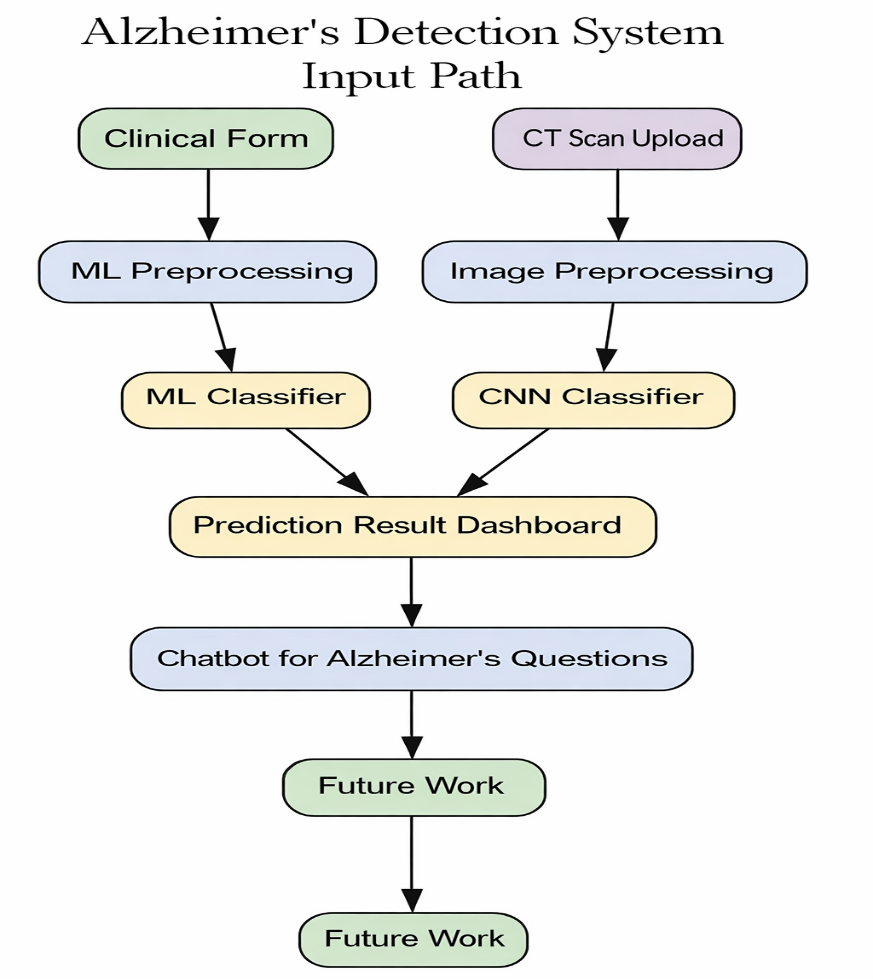
Alzheimer’s disease is a progressive neurodegenerative disorder that significantly impairs memory and cognitive functions and affects over 55 million people worldwide. The successful management and planning require early and accurate diagnosis. Conventional radiological assessment is often subjective and time-consuming, which highlights the need for automated and reliable diagnostic solutions. Most deep learning models show promise for classifying neuroimaging data, but they tend to be less computationally efficient and less interpretable, and they cannot be integrated into patient-centric processes. The gap between developing diagnostic algorithms with high accuracy and implementing them in a supportive framework that includes patients and caregivers is large. This paper introduces a comprehensive, hybrid framework that addresses these gaps. We present a dual-modality diagnostic system: a deep learning pipeline using EfficientNetV2-S for CT scan classification, complemented by a Feedforward Neural Network (FNN) that analyses structured clinical data for holistic patient assessment. This diagnostic core is integrated into a user-friendly graphical user interface (GUI) and supplemented by ”NeuroBot,” an AI-powered chatbot that provides domain-specific information and support. The two models have been trained using the transfer learning method on a curated dataset of 30,000 brain CT slices. The EfficientNetV2-S model achieved an accuracy of 98.19%. After hyperparameter tuning, the FNN model achieved an optimised accuracy of 87.21%. The importance of the features addressed by the models was proved with the help of the statistical t-tests of the corresponding clinical data. The integrated system enables a scalable, translatable, and patient-centered system to improve the early analysis and treatment of Alzheimer’s disease.
References
1. S. Alinsaif, “Dca-enhanced alzheimer’s detection with shearlet and deep learning integration,” Computers in Biology and Medicine, vol. 185, p. 109538, 2025, doi:https://doi.org/10.1016/j.compbiomed.2024.109538. DOI: https://doi.org/10.1016/j.compbiomed.2024.109538
2. M. Srikanth and P. Bellapukonda, “The early detection of alzheimer’s illness using machine learning and deep learning algorithms,” Journal of Pharmaceutical Negative Results, vol. 13, no. 9, pp. 4852–4859, 2022, doi:https://doi.org/10.47750/pnr.2022.13.S09.603. [Online]. Available: https://www.pnrjournal.com/index.php/home/article/view/4470
3. E. M. Mohammed, A. M. Fakhrudeen, and O. Y. Alani, “Detection of alzheimer’s disease using deep learning models: A systematic literature review,” Informatics in Medicine Unlocked, vol. 50, p. 101551, 2024, doi:https://doi.org/10.1016/j.imu.2024.101551. DOI: https://doi.org/10.1016/j.imu.2024.101551
4. A. D. Arya et al., “A systematic review on machine learning and deep learning techniques in the effective diagnosis of alzheimer’s disease,” Brain Informatics, vol. 10, no. 1, p. 17, 2023, doi:https://doi.org/10.1186/s40708-023-00195-7. DOI: https://doi.org/10.1186/s40708-023-00195-7
5. N. Pradhan, S. Sagar, and A. S. Singh, “Analysis of mri image data for alzheimer disease detection using deep learning techniques,” Multimedia Tools and Applications, vol. 83, no. 6, pp. 17 729–17 752, 2024, doi:https://doi.org/10.1007/s11042-023-16256-2. DOI: https://doi.org/10.1007/s11042-023-16256-2
6. P. Kishore, C. U. Kumari, M. Kumar, and T. Pavani, “Detection and analysis of alzheimer’s disease using various machine learning algorithms,” Materials today: proceedings, vol. 45, pp. 1502–1508, 2021, doi:https://doi.org/10.1016/j.matpr.2020.07.645. DOI: https://doi.org/10.1016/j.matpr.2020.07.645
7. P. Balaji, M. A. Chaurasia, S. M. Bilfaqih, A. Muniasamy, and L. E. G. Alsid, “Hybridized deep learning approach for detecting alzheimer’s disease,” Biomedicines, vol. 11, no. 1, p. 149, 2023, doi:https://doi.org/10.3390/biomedicines11010149. DOI: https://doi.org/10.3390/biomedicines11010149
8. S. Mirabian, F. Mohammadian, Z. Ganji, H. Zare, and E. Hasanpour Khalesi, “The potential role of machine learning and deep learning in differential diagnosis of alzheimer’s disease and ftd using imaging biomarkers: A review,” The Neuroradiology Journal, vol. 38, no. 5, pp. 571–587, 2025, doi:https://doi.org/10.1177/19714009251313511. DOI: https://doi.org/10.1177/19714009251313511
9. J. Chua et al., “Utilizing deep learning to predict alzheimer’s disease and mild cognitive impairment with optical coherence tomography,” Alzheimer’s & Dementia: Diagnosis, Assessment & Disease Monitoring, vol. 17, no. 1, p. e70041, 2025, doi:https://doi.org/10.1002/dad2.70041. DOI: https://doi.org/10.1002/dad2.70041
10. A. A. A. El-Latif, S. A. Chelloug, M. Alabdulhafith, and M. Hammad, “Accurate detection of alzheimer’s disease using lightweight deep learning model on mri data,” Diagnostics, vol. 13, no. 7, p. 1216, 2023, doi:https://doi.org/10.3390/diagnostics13071216. DOI: https://doi.org/10.3390/diagnostics13071216
11. K. Lokesh, N. P. Challa, A. S. Satwik, J. C. Kiran, N. K. Rao, and B. Naseeba, “Early alzheimer’s disease detection using deep learning,” EAI Endorsed Transactions on Pervasive Health and Technology, vol. 9, 2023, doi:https://doi.org/10.4108/eetpht.9.3966. DOI: https://doi.org/10.4108/eetpht.9.3966
12. S. Balne and A. Elumalai, “Machine learning and deep learning algorithms used to diagnosis of alzheimer’s,” Materials Today: Proceedings, vol. 47, pp. 5151–5156, 2021, doi:https://doi.org/10.1016/j.matpr.2021.05.499. DOI: https://doi.org/10.1016/j.matpr.2021.05.499
13. S. Baskar, M. L. Prasad, N. Sharma, T. Katale, P. C. S. Reddy et al., “An accurate prediction and diagnosis of alzheimer’s disease using deep learning,” in IEEE North Karnataka Subsection Flagship International Conference (NKCon). IEEE, 2023, pp. 1–7, doi:https://doi.org/10.1109/nkcon59507.2023.10396132. DOI: https://doi.org/10.1109/NKCon59507.2023.10396132
14. A. Muydinov, “Advances in deep learning techniques for alzheimer’s disease detection using mri images review,” in Proceedings of the 8th International Conference on Future Networks & Distributed Systems, 2024, pp. 266–269, doi:https://doi.org/10.1145/3726122.3726160. DOI: https://doi.org/10.1145/3726122.3726160
15. G. N. Alwakid, S. Tahir, M. Humayun, and W. Gouda, “Improving alzheimer’s detection with deep learning and image processing techniques,” IEEE Access, vol. 12, pp. 153 445–153 456, 2024, doi:https://doi.org/10.1109/ACCESS.2024.3481238. DOI: https://doi.org/10.1109/ACCESS.2024.3481238
16. G. S. Chhabra, A. Guru, B. J. Rajput, L. Dewangan, and S. K. Swarnkar, “Multimodal neuroimaging for early alzheimer’s detection: a deep learning approach,” in 14th international conference on computing communication and networking technologies (ICCCNT). IEEE, 2023, pp. 1–5, doi:https://doi.org/10.1109/ICCCNT56998.2023.10307780. DOI: https://doi.org/10.1109/ICCCNT56998.2023.10307780
17. S. Afzal et al., “Alzheimer disease detection techniques and methods: A review.” International journal of interactive multimedia and artificial intelligence, vol. 6, no. 7, pp. 26–38, 2021, doi:https://doi.org/10.9781/ijimai.2021.04.005. DOI: https://doi.org/10.9781/ijimai.2021.04.005
18. S. Koga, A. Ikeda, and D. W. Dickson, “Deep learningbased model for diagnosing alzheimer’s disease and tauopathies,” Neuropathology and Applied Neurobiology, vol. 48, no. 1, p. e12759, 2022, doi:https://doi.org/10.1111/nan.12759. DOI: https://doi.org/10.1111/nan.12759
19. I. Ayus and D. Gupta, “A novel hybrid ensemble based alzheimer’s identification system using deep learning technique,” Biomedical Signal Processing and Control, vol. 92, p. 106079, 2024, doi:https://doi.org/10.1016/j.bspc.2024.106079. DOI: https://doi.org/10.1016/j.bspc.2024.106079
20. S. Suganyadevi, A. S. Rajasekaran, N. Satheesh, R. Suganthi, R. Naveenkumar et al., “Alzheimer’s disease diagnosis using deep learning approach,” in 2023 Second International Conference on Electronics and Renewable Systems (ICEARS). IEEE, 2023, pp. 1205–1209, doi:https://doi.org/10.1109/ICEARS56392.2023.10085017. DOI: https://doi.org/10.1109/ICEARS56392.2023.10085017
21. J. L. Ávila-Jiménez, V. Cant´on-Habas, M. del Pilar Carrera-Gonz´alez, M. Rich-Ruiz, and S. Ventura, “A deep learning model for alzheimer’s disease diagnosis based on patient clinical records,” Computers in Biology and Medicine, vol. 169, p. 107814, 2024, doi:https://doi.org/10.1016/j.compbiomed.2023.107814. DOI: https://doi.org/10.1016/j.compbiomed.2023.107814
22. S. Savaş, “Detecting the stages of alzheimer’s disease with pre-trained deep learning architectures,” Arabian Journal for Science and Engineering, vol. 47, no. 2, pp. 2201–2218, 2022, doi:https://doi.org/10.1007/s13369-021-06131-3. DOI: https://doi.org/10.1007/s13369-021-06131-3
23. W. Al Shehri, “Alzheimer’s disease diagnosis and classification using deep learning techniques,” PeerJ Computer Science, vol. 8, p. e1177, 2022, doi:https://doi.org/10.7717/peerj-cs.1177. DOI: https://doi.org/10.7717/peerj-cs.1177
24. T. J. Saleem et al., “Deep learning-based diagnosis of alzheimer’s disease,” Journal of Personalized Medicine, vol. 12, no. 5, p. 815, 2022, doi:https://doi.org/10.3390/jpm12050815. DOI: https://doi.org/10.3390/jpm12050815
25. G. Hcini, I. Jdey, and H. Dhahri, “Investigating deep learning for early detection and decision-making in alzheimer’s disease: A comprehensive review: G. hcini et al.” Neural Processing Letters, vol. 56, no. 3, p. 153, 2024, doi:https://doi.org/10.1007/s11063-024-11600-5. DOI: https://doi.org/10.1007/s11063-024-11600-5
26. S. Jain and R. Srivastava, “Enhanced eeg-based alzheimer’s disease detection using synchrosqueezing transform and deep transfer learning,” Neuroscience, vol. 576, pp. 105–117, 2025, doi:https://doi.org/10.1016/j.neuroscience.2025.04.041. DOI: https://doi.org/10.1016/j.neuroscience.2025.04.041
27. H. A. Helaly, M. Badawy, and A. Y. Haikal, “Deep learning approach for early detection of alzheimer’s disease,” Cognitive computation, vol. 14, no. 5, pp. 1711–1727, 2022, doi:https://doi.org/10.1007/s12559-021-09946-2. DOI: https://doi.org/10.1007/s12559-021-09946-2
28. T. Vanaja, K. Shanmugavadivel, M. Subramanian, and C. Kanimozhiselvi, “Advancing alzheimer’s detection: integrative approaches in mri analysis with traditional and deep learning models,” Neural Computing and Applications, vol. 37, no. 14, pp. 8527–8546, 2025, doi:https://doi.org/10.1007/s00521-025-10993-1. DOI: https://doi.org/10.1007/s00521-025-10993-1
29. M. M. S. Fareed et al., “Add-net: an effective deep learning model for early detection of alzheimer disease in mri scans,” IEEE Access, vol. 10, pp. 96 930–96 951, 2022, doi:https://doi.org/10.1109/ACCESS.2022.3204395. DOI: https://doi.org/10.1109/ACCESS.2022.3204395
30. E. Kina, “Tleablcnn: Brain and alzheimer’s disease detection using attention based explainable deep learning and smote using imbalanced brain mri,” IEEE Access, 2025, doi:https://doi.org/10.1109/ACCESS.2025.3539550. DOI: https://doi.org/10.1109/ACCESS.2025.3539550
31. M. Taiyeb Khosroshahi et al., “Explainable artificial intelligence in neuroimaging of alzheimer’s disease,” Diagnostics, vol. 15, no. 5, p. 612, 2025, doi:https://doi.org/10.3390/diagnostics15050612. DOI: https://doi.org/10.3390/diagnostics15050612
Published
Issue
Section
License
Copyright (c) 2026 The Authors. Published by BenchCouncil Press on Behalf of International Open Benchmark Council

This work is licensed under a Creative Commons Attribution-NonCommercial-NoDerivatives 4.0 International License.